Tag: sales

  • Doing The New Client Dance . . .

    Doing The New Client Dance . . .

    As consultants, we’re constantly receiving client requests for information, meeting new people at events and meetings, receiving RFPs, creating proposals for potential work, when we’re not creating new research projects, analyzing data or meeting with existing clients – in short, there’s a constant cycle of clients in an out, all of which need attention of various kinds. This is normally a good problem to have, but there’s a trap in there that can and should be avoided.

    Even with top-notch marketing, a full sales funnel, and great clients, there are many prospects who solicit our attention that should not ever become actual clients. Unfortunately, they look on the surface just like the one’s that should! How to tell the difference? Of course, tighter lead screening, higher vetting standards, and other preliminary processes will cut down on the tire-kickers and time wasters. But what about those who seem earnest, sincere and clearly need help, but that end up wasting a lot of time and asking lots of questions, but don’t ever really have the wherewithal or ability to engage at the stated fee level or project scope? You’ve gotten to know them, you’ve adjusted timelines to allow for lower budget milestones, they’ve stated their desire, but either can’t or don’t act, sign the contract and start gathering information to engage the service.

    Were there signs of this type of behavior earlier in the process, flags that were missed or ignored? My guess is yes, but without a high level of transaction volume, they can each be explained away as an anomaly or one-off problem, so that no trend or pattern develops. This kind of activity negatively affects productivity and profitability, so it’s worth a little time to track down the commonalities and causes for this type of behavior on the part of the prospect. Here’s a few additional flags we’ve uncovered:

    • Have they ever worked with a consultant or freelancer before? Unless their corporate culture and structure and budget type allow for the use of freelance labor, especially hourly or open ended contracts, beware. It’s not something to enter into lightly, and their ability to work with you largely depends on them being comfortable with the arrangement, both ideologically and financially. If it’s a new thing, you’re the guinea pig in the experiment, and the risk is extremely high for you as the consultant.
    • Have they set aside the management time and the access that comes with it, to give you the real story? Many first time consulting clients think that once we’re signed on, it’s all on us, and they just circle back around at the end for the report. Nothing could be further from the truth, especially for marketing – we need some time and interaction to download all the info we need to do the job, and it’s got to come from the top.
    • Have they set aside enough budget to not only cover the consulting fees and time, but to pay to enact and execute the activity the consultant recommends? If not, your work simply becomes another binder on a shelf, and the opportunity to actually move the needle and grow that company in a meaningful way is likely lost. Not to mention your ability to capitalize on that relationship with further billable hours or additional projects.

    Most of the above can be squared away with a very direct, frank conversation at the beginning of the relationship, to set expectations on both sides, assess suitability of both structure and finances, and to set some goals that everyone’s comfortable with. Setting expectations is key to a well-rounded relationship and should be an integral part of any formal or informal “onboarding” process you currently employ. Even with more seasoned clients, who rely primarily on the contract language and scope of work documents to outline what will be delivered and what will be needed to achieve it, a brief conversation with the more senior management contacts is required, just to set all concerned at ease going forward.

    While you can’t always spot a “good” client or a “bad” one at first blush, but with some careful questioning and a solid process, you can reduce the lost time and increase profitability in real world practice, allowing you to grow and expand as time allows – you can only be so many places at once, after all . . .

  • Are You Selling To The Right People?

    Are You Selling To The Right People?

    We’re big advocates of using research, especially primary customer research, to drive marketing and sales efforts. It’s much more difficult to miss the target when the target is telling you how to hit it, how far away it is, and where your arrow is in relation to itself.

    Sales benefits as much from research as Marketing does, but in different ways, and by using different pieces of data. Primarily, Sales will be ale to use data to determine who is, and how well-qualified is, the audience of one (company) in front of them. With a list of several hundred prospects in their satchel, Sales people have to determine if this company is even realistically a prospect at this time, who inside that company they should approach, who the actual decision-maker is, and how best to reach out to them to get the warmest reception.

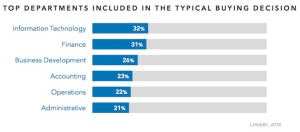
    New research has shown that trying to pinpoint a single individual decision-maker may be a futile and even damaging effort. Corporations are so integrated, so closely cooperative, in an effort to move forward more effectively, to make purchasing of goods and services more streamlined, and maximize cost-effective use of resources, that an average of 3.4 departments get “in on the purchasing decision”.


    departments-LG-linkedin-100516


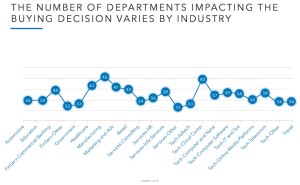
    That number differs depending on the industry, with manufacturing scoring a surprising 4.6 departments needed to make a purchasing decision, and some smaller non-profits scoring a 2.1 or less. Reasons for this are less clear, but the prevailing theory is that the classic manufacturing firm has fewer distributed costs, centralized purchasing for raw materials, and the purchase affects more departments’ budgets and ability to function as a result. Fewer “silos” leads to more people involved in making decisions.

    Which departments are involved makes the picture for Sales even murkier, with variables including cost of the purchase made, length of the sales process, number of touchpoints that selling company has with the target firm, and the nature or structure of the product or service being bought. Things like consulting services, legal assistance, accounting services, tend to have more folks weigh in on the decision, based on the number of departments such an engagement will touch within the company. Things like maintenance and physical plant services typically fall so squarely within Operations, with a touch on accounting and finance, that usually there is only one true decision-maker. The decision to spend the money has more involvement, but the actual vendor is pretty straightforward and stays “local” most of the time.


    influence-linkedin-100516


    The bottom line is that sales people need to do a certain amount of probing and due diligence when qualifying prospects to make sure they are not only aware of all the various inputs in the buying decision, but that key stakeholder are not “left out” of the communication chain, to avoid making them feel ignored or worse, disenfranchised. That kind of innocent mistake can torpedo even the most potent sales effort, and it may be happening and you don’t even know it.

    The time spent doing this type of research is almost always time well invested, if for no other reason than to allow the sales person to speak with confidence about the target company. Additionally, it avoids the type of error described above, and allows you to streamline the process and avoid real time-wasters, like selling for months to the wrong person(s).

    This type of information should be prominently noted in your CRM entries as well for each prospect, not only as a reminder to you, but as a signal to others viewing the reports, who may be able to suggest a new approach, or use a contact in a department you have yet to approach. Share the wealth.

    Do your homework, include and approach the “right” people, and be aware that it will likely take a unanimous decision among up to four full departments to close the sale. Knowledge is power in this instance – go forth and be powerful!

  • Persistence More Important Than Ever To Close The Sale

    Persistence More Important Than Ever To Close The Sale

    In the modern world, the practice of sales, whether it be called “Account-based Marketing” or Business Development, or some other euphemism, is as tough as it’s ever been to be effective. With over a thousand marketing messages or more hitting the average citizen every single day, it’s harder than ever to cut through the clutter, to get people’s attention, to gain their engagement and their focus for even a few moments, let alone tell a compelling story and persuade them to take whatever action that moves the needle for your firm. One of the most effective tactics is one of the oldest, and it still works in today’s environment – persistence.

    We’ve all seen the memes online for success in sales, indicating that most B2B sales are made after the 12th or 14th contact with a prospect, less than 5% get made after the initial contact, etc. A key ingredient seems to be “keeping after the prospect until they cave in and buy.” I don’t frame it that way to sales-based clients, but that’s essentially what you’re trying to do. Entire systems and software platforms have been created and sold based on this endless tracking and following strategy, scheduling the next contact, ranking the viability and likelihood of a sale, gauging their ability to buy, and when. The systematization, the automation of the sales process has been driven to new levels in an attempt to counter this profusion of messages and the shortening attention span of the prospect audience.

    Technology has made this not only possible, but extremely easy, and as a result, sales management of all stripes have latched onto this approach as a way of integrating sales into their other business processes. You can now track and call a “Lead” anyone who clicks on a link in a search results report. And beyond that, you can have your messaging and tracking follow them on their entire journey through the ether that is the Internet, popping up whenever and wherever they travel.

    This is sales?

    True sales professionals know that these are simply tools, not replacements for a solid set of skills, like active listening, seeking out pain points, probing for possible objections, collaboratively crafting solutions, over-delivering and under-promising. The essence of all of these things is that you have to actually get in front of and speak directly with people who make the buying decision. Conducting sales activities “remotely” will only take you so far, at some point you have to interface with the customer. Usually more than one such engagement is required, because the basis of a sale is trust n the sales person, and trust in the company behind them to back up their promises and claims, and that trust takes several encounters to achieve. Hence the need for persistence, to keep coming up with a new, compelling reason to get in front of that prospect and convincing them to see things your way.

    The skill in all this occasionally takes the form of sensitivity – the gauge of how tolerant the prospect will be in receiving follow-up messages, calls, e-mails, communications from the sales person, before they start to work against them and annoy the prospect. Persistence is not just being relentless. It’s being in contact on a regular, ongoing basis, and offering something of value to the client with each interaction, building trust progressively, offering to work the prospect through whatever challenge you’ve agreed they face together, showing them how you’ll achieve the desired result. For professional services or big-ticket items, the consultative approach is by far the most effective.

    And that takes persistence.

    If you’re on the fifth or sixth contact with a well-qualified prospect, it may seem like overkill, but if you hang in there, the seventh touch may be the charm. For efficiency’s sake, the game is to try and reduce that number of touches to the most effective use of your time and resources without negatively affecting the outcome. But if you plan on investing significant time with each prospect, and have a constantly full pipeline of incoming prospects, eventually a rhythm develops and you can gauge how many touches are required for each one, and can start to predict and plan your time investment accordingly.

    As each one moves through the pipeline toward the close, a new one starts with an initial interview, and proceeds through the consultative system toward a close and into the delivery or service phase. By being systematically persistent, you’ve remained top-of-mind without being annoying and driving interest downward, provided the prospect with value before the sale, and shown your ability to deliver, to keep to a schedule, to bring something to the table, and have developed trust.

    Now that’s sales!

    Mechanizing, automating, scoring, tracking, weighting, prioritizing, and all the other functions are merely supports for the basic activity of communicating effectively and persistently with the customer to achieve a result. Of course all this communication has lots of other benefits as well, since the more you know and can learn about the customer, the more effective you can make the solution you’re delivering, and the more opportunity you can uncover for additional sales interaction with them – they’ve told you what they want, you just have to deliver it at the right time in the relationship.

    Message clutter, short attention spans, over-scheduling, software profusion, excessive meaningless contacts and content in the inbox, are all enemies of the practice of effective sales, which requires honest, direct, persistent communication with actual people. Everything else is distraction, which won’t put food on the salesperson’s table, or fill the company coffers with anything but empty promises. Avoid distraction, dig in, and connect with prospects – they’ll appreciate your honesty, and enjoy the attention.

  • Engagement Is Good, Revenue Is Better

    Engagement Is Good, Revenue Is Better

    There is a lot of buzz among marketers about fostering customer engagement, building engagement with apps and websites, creating communities with blogs and social selling. It all sounds great on paper, we should all work together, share your purchases socially, everybody knows everything you do, everyone’s on your side, we’re all a village, cumbaya . . . But when you’re standing in the aisle at Wal-Mart deciding what frozen dinner brand or dog food to buy, I don’t feel that my level of engagement with Purina’s website is the deciding factor. Marketing is about raising awareness in a positive way to influence and drive SALES. I can be as engaged as can be with a brand, but if a similar product is in front of me, and they are largely the same, engagement doesn’t trump quality, availability and price, and the sale will go to the one who fits those three criteria the closest. Even with B2B sales, I’ve been “engaged” with a number of websites and businesses prospecting my business via e-mail and other devices, but haven’t actually bought anything from any of them – I’d score really high on their “engagement scale” algorithm, but they haven’t made a dime off of me, and may never do so.


    Brand engagement is a long-term play. It needs to be tied to other awareness vehicles, timed promotions, backup media, and ongoing evolution of product benefit awareness in order to really be effective at driving sales. This is not a new idea, but it’s one which has risen to prominence recently along with the ubiquity of social media platforms, which provide the ability for person-to-person communication in a way heretofore not possible on the current scale. I can now tell thousands of people what I’m doing, what I’m interested in, what I’m buying, what I’m eating, cooking, enjoying, drinking, and more on a moment’s notice in real time. That means that if I’m sharing it with others, it’s boosting their awareness as well as my own for a particular product, service or item. That kind of organic, exponential awareness spread at that speed was unheard of just 15 years ago. Epidemiologists are familiar with the concept, but marketers only recently began to apply it to their efforts – indeed the term “going viral” is borrowed from the disease spread specialists, as information, or awareness, can spread a lightning speed unseen from the outside, like a virus.


    Just because I’m aware of a product or service that I’ve engaged with it on the Internet, does not mean that when the time comes I’m actually going to make a purchase. It may increase the odds some, but as we learned with the recent Powerball drawing, odds need to be changed significantly with a supreme effort in order to really affect the outcome. Social media engagement or website engagement is like buying 100 lottery tickets instead of one. It seems like you’ve boosted your chances of winning by 100 fold, but in reality, those other 99 tickets didn’t even move the needle.


    By all means, do A/B testing, make adjustments, formulate campaigns that include a mechanism for increasing engagement, but depending upon it to drive significant revenue could be a mistake. The basics of building ongoing awareness through media your audience utilizes, timing your efforts to coincide with that target’s needs or life-stage position, matching your demographics and psychographics and messaging to that of the prospective customer, are still the linchpins of successful marketing efforts, and enhancements and refinements to these, along with some boosts in awareness through effective promotion of specialty offers, benefit driven messaging, and creative imagery, will drive revenue upward on a consistent basis as the brand evolves and the audience grows. If you’ve got all those bases covered effectively, engagement is a nice to have, the icing on the cake, and a good set up for the upsell and cross sell to that customer base, due to the added time allowed for an opportunity to develop.


    Unless I miss my guess, the folks dwelling on engagement (which is notoriously hard to measure with any accuracy) don’t have all the basics in place and need a buzz word and a crutch to help them explain why things on the sales side aren’t moving as far or as fast as expected.


    Dwell on the basics of marketing, make sure all the right pieces are in place and working together efficiently, and keeping the pipeline full, then worry about engagement.

  • Sometimes, a Frontal Assault Loses The Sales Battle

    Sometimes, a Frontal Assault Loses The Sales Battle

    I was speaking with a top marketer and high-powered sales professional (yes, the two skills are not mutually exclusive), and the conversation drifted to how he made approaches to prospective clients and how HE liked to be approached. The two were the same, and clearly it’s lead him to experience fantastic success, based upon his story and current situation.

    He shared with me that “once I discovered this secret, I quit “selling” and just had a conversation.” He related how he had been approaching clients with qualifying questions, asking them about their business, and subsequently telling them and showing them how his expertise could provide solutions, how they had helped others in similar situations, and here were the reasons why. The is a common approach, one most sales people take to generated leads, warm calls, those they have no real personal relationship with prior to the initial conversation. It’s a frontal assault, based on the ABC (Always Be Closing) school of sales, which works great for high volume, turn-and-burn, broad-based consumer sales. It’s high-pressure, high speed, high-volume approach that will, with some minor tweaks, meet the numbers goal almost every time if enough approaches are made. But it doesn’t usually lead to the most loyal clients, or the most profitable, and certainly not the longest term clients, those who provide life-time value which is 10-20 times higher than the initial transaction value.

    For long-term, relationship-based, loyalty-rewarded business-to-business sales, this type of approach is less successful, and can be annoying and offensive to the executive to whom it is directed – it’s disrespectful to think that such an individual is going to make a quick, ill-considered purchasing decision, on his own, without due diligence, without internal consultation, right in front of the salesperson. Not happening.

    Sometimes a more subtle, staged approach is more appropriate – and more successful! This is not a style issue, it’s a functional reality. People want to do business with those they trust, and to come straight at someone without knowing anything substantive about them, and put pressure on them to make a purchasing decision, on what usually is a fairly high-ticket spend, does not inspire trust – someone worthy of my trust would know better . . .

    Now, for the secret my colleague imparted. His conversations don’t revolve around benefits, features, cost, product production schedules, arcane back-office technology, or even specific results. His conversations center around discovering the nature and often the source of the problem, the pain point the prospect is suffering from. Once that is established, no promises of a solution are made, but a commitment is asked of the prospect to explore a couple of ideas further, and see if the relationship is likely to work. That way they can both see that the steps recommended are sensible and effective, but also that each side has at least an emotional skin in the game, they’ve both committed to give TIME and EFFORT to solving the problem. Cost is not the central focus, indeed it may not even be mentioned.

    In a nutshell, the secret is to solve problems that both parties have agreed are problems and have agreed to work together to solve. It’s a common path, not a push-down strategy, and it works to “knock down walls” and reduce resistance, and craft a reasonable, fair and honest business relationship.

    Try this with your next solid prospect, and see what the results are. We all have to give to get, and with this simple secret, you get both.

  • Selling Is Not About Relationships

    Selling Is Not About Relationships

    Reposted courtesy of HBR, copyright 2011
    Matthew Dixon is Managing Director of the Corporate Executive Board’s Sales and Service Practice. Brent Adamson is Senior Director of the Sales Executive Council, a division of the Sales and Service Practice. Their new book, The Challenger Sale: Taking Control of the Customer Conversation, is forthcoming November 10, 2011 from Portfolio/Penguin.

    This post, the first of a four-part series, is also part of the HBR Insight Center Growing the Top Line.

    Ask any sales leader how selling has changed in the past decade, and you’ll hear a lot of answers but only one recurring theme: It’s a lot harder. Yet even in these difficult times, every sales organization has a few stellar performers. Who are these people? How can we bottle their magic?

    To understand what sets apart this special group of sales reps, the Sales Executive Council launched a global study of sales rep productivity three years ago involving more than 6,000 reps across nearly 100 companies in multiple industries.

    We now have an answer, which we’ve captured in the following three insights:


    1. Every sales professional falls into one of five distinct profiles.

    Quantitatively speaking, just about every B2B sales rep in the world is one of the following types, characterized by a specific set of skills and behaviors that defines the rep’s primary mode of interacting with customers:

    • Relationship Builders focus on developing strong personal and professional relationships and advocates across the customer organization. They are generous with their time, strive to meet customers’ every need, and work hard to resolve tensions in the commercial relationship.
    • Hard Workers show up early, stay late, and always go the extra mile. They’ll make more calls in an hour and conduct more visits in a week than just about anyone else on the team.
    • Lone Wolves are the deeply self-confident, the rule-breaking cowboys of the sales force who do things their way or not at all.
    • Reactive Problem Solvers are, from the customers’ standpoint, highly reliable and detail-oriented. They focus on post-sales follow-up, ensuring that service issues related to implementation and execution are addressed quickly and thoroughly.
    • Challengers use their deep understanding of their customers’ business to push their thinking and take control of the sales conversation. They’re not afraid to share even potentially controversial views and are assertive — with both their customers and bosses.


    2. Challengers dramatically outperform the other profiles, particularly Relationship Builders.

    When we look at average reps, we find a fairly even distribution across all five of these profiles. But while there may be five ways to be average, there’s only one way to be a star. We found that Challenger reps dominate the high-performer population, making up close to 40% of star reps in our study.

    What makes the Challenger approach different?

    The data tell us that these reps are defined by three key capabilities:

    • Challengers teach their customers. They focus the sales conversation not on features and benefits but on insight, bringing a unique (and typically provocative) perspective on the customer’s business. They come to the table with new ideas for their customers that can make money or save money — often opportunities the customer hadn’t realized even existed.


    • Challengers tailor their sales message to the customer They have a finely tuned sense of individual customer objectives and value drivers and use this knowledge to effectively position their sales pitch to different types of customer stakeholders within the organization.


    • Challengers take control of the sale. While not aggressive, they are certainly assertive. They are comfortable with tension and are unlikely to acquiesce to every customer demand. When necessary, they can press customers a bit — not just in terms of their thinking but around things like price.


    We’ll discuss each of these capabilities in more depth in our upcoming posts, but just as surprising as it is that Challengers win, it’s almost more eye-opening who loses. In our study, Relationship Builders come in dead last, accounting for only 7% of all high performers.

    Why is this? It’s certainly not because relationships no longer matter in B2B sales–that would be a naïve conclusion. Rather, what the data tell us is that it is the nature of the relationships that matter. Challengers win by pushing customers to think differently, using insight to create constructive tension in the sale. Relationship Builders, on the other hand, focus on relieving tension by giving in to the customer’s every demand. Where Challengers push customers outside their comfort zone, Relationship Builders are focused on being accepted into it. They focus on building strong personal relationships across the customer organization, being likable and generous with their time. The Relationship Builder adopts a service mentality. While the Challenger is focused on customer value, the Relationship Builder is more concerned with convenience. At the end of the day, a conversation with a Relationship Builder is probably professional, even enjoyable, but it isn’t as effective because it doesn’t ultimately help customers make progress against their goals.

    This finding — that Challengers win and Relationship Builders lose — is one that sales leaders often find deeply troubling, because their organizations have placed by far their biggest bet on recruiting, developing, and rewarding Relationship Builders, the profile least likely to win.

    Here’s how one of our members in the hospitality industry put it when he saw these results: “You know, this is really hard to look at. For the past 10 years, it’s been our explicit strategy to hire effective Relationship Builders. After all, we’re in the hospitality business. And, for a while, that approach worked well. But ever since the economy crashed, my Relationship Builders are completely lost. They can’t sell a thing. And as I look at this, now I know why.”


    3. Challengers dominate the world of complex “solution-selling”

    Given the first two findings, it might be reasonable to conclude that Challengers are the down-economy reps and that when things return to normal, Relationship Builders will once again prevail. But our data suggest that this is wishful thinking.

    When we cut the data by complexity of sale — that is, separating out transactional, product-selling reps from complex, solution-selling reps — we find that Challengers absolutely dominate as selling gets more complex. Fully 54% of all star reps in a solution-selling environment are Challengers. At the same time, Relationship Builders fall off the map almost entirely, representing only 4% of high-performing reps in complex environments.

    Put differently, Challengers win because they’ve mastered the complex sale, not because they’ve mastered a complex economy. Your very best sales reps — the ones who carried you through the downturn — aren’t just the top performers of today but the top performers of tomorrow, as they are far better able to drive sales and deliver customer value in any kind of economic environment. For any company on a journey from selling products to selling solutions — which is a migration that more than 75% of the companies I work with say they are pursuing — the Challenger selling approach represents a dramatically improved recipe for driving top-line growth.

    If you found this valuable, you can have more like this delivered to your inbox weekly – FREE, just by subscribing to this blog above. And, don’t forget to pick up your copy of “The Marketing Doctor’s Survival Notes”


  • Promotional Items Should Be Carefully Selected for Maximum Impact

    Promotional Items Should Be Carefully Selected for Maximum Impact

    There are lots of elements to be considered if your marketing plan for the year includes participation in tradeshows, and a number of good reasons to include it in your plan in the first place. One element that has been closely focused on over the years, sometimes to the exhibitors detriment: the tradeshow “giveaway”. The use of promotional items for creating lasting attention and retention of brand image has cycled up and down in popularity over the last 50 years or so. There are some interesting correlations between the state of the economy and the level of quantity and sophistication attached to the promotional items given out at shows. In general, when times get tough, the quantity goes up, and the quality/cost goes down. When times are hard, something in marketers minds says “better to give away lots of cheap stuff just to get the name out there, than to spend the same but only give away half as many nice items that actually connect accurately to the brand”. Why, I have no idea, but it’s bunk.

    In reality, if you choose to distribute promotional items at a tradeshow, that choice should be as well-thought-out as the display construction, the sales training scheme for the event, the selection of size and location of the stand, and the selection of representatives working the show. Often such items are an afterthought, an add-on after everything else has been decided. Sometimes, there are “Standard” items that the company keeps a stock of, or makes available to each location for marketing purposes – they get a better price buying in higher quantity, and they make available or distribute it throughout their “system” for use in ad hoc marketing efforts, including local tradeshows. Ever visited a home improvement show, and the local bank has purchased a table space and brings water bottles and stress balls, and thinks this will make them memorable to the attendees and that they will open an account or apply for a loan? For the impact that really has on the audience, they may as well have taken the money and put it in one of those plexiglass Grab-a-Buck boxes – that at least connects money and banks in people’s minds and might have gotten them some attention!

    If you’ve made the decision to promote your business with a branded item, if that selection is made carefully, it can be of great benefit at that event, and can drive recognition and awareness, not necessarily sales. If really obvious, it can create buzz on the show floor and drive traffic to your display from elsewhere on the floor. And if you’ve really read the audience right, that item will be so specific to a particular population that it will help qualify that traffic and thin and focus the lead selection before they arrive! Now that’s a promotion.

    Some general rules of thumb for a successful promotional item giveaway.

    1) If you can do so, and it’s appropriate, try passing out samples of the product. Smaller, not necessarily fully functional, but a good replica of your product will at least remind the recipient for months to come, who gave them that item and what they make.

    2) If you can’t sample, for whatever reason, select something that links practically to what you do or what you offer. This type of item at least will carry some activation, that coupled with the logo printed on the item, will conjure up a memory of your firm and what it offers.

    3)If you can’t sample, and you can’t link practically with your product, link with the audiences habits or industry specific needs or processes. If you’re marketing to engineers, a measuring device of some type is a good example of this – they can actually use the item at work, where they hopefully make purchasing decisions.

    4) If you can’t do 1, 2, or 3, at least make the item something useful or entertaining and of good quality, including the imprint method. Also, be aware of the audience. If you can, try to select items that are at least non-toxic – sounds strange, but I can’t tell you how many stress balls and foam toys I’ve handed to my young kids only to find out the printing rubbed off when they got drool on it, or put it in their mouths.

    In short, smart, engaging, creative choices that engage the audience’s imagination, trigger a memory of what you do, your products or your brand promise, that are practical and useful within your industry are the best bets for effective giveaways.

    There are lots of other tips and tricks to using promotional items to drive traffic and leads. More later . . .

  • Key Marketing Element – Define “Value”

    Key Marketing Element – Define “Value”

    Whether we’re creating a marketing plan, implementing a creative campaign or setting up for a key sales call, there is always a big question lurking in the background of all of our efforts – “What is the value of our product/service to the customer?”

    Most marketers can create a list of features that show off their product, might even do enough to differentiate it from competitors, but features don’t really drive response or sales. A list of benefits, what good things your product or service will result in for the customer is better, and will drive response and sales. But showing value, real intrinsic and perceived value, is where the true art of observation, listening, distillation and research converge to drive real results. This is where experience will pay off.

    Take for example a simple cleaning service: the features they might offer include trained personnel, bonded service agents, natural or organic or hypoallergenic cleaning products, long-term contacts and one-time specials for realtors and landlords. But those features will make the reader work to derive the benefits from them, if you’re lucky. More likely they will go on to the next competitor.

    Benefits derived from these might include peace of mind for landlords and homeowners, high quality cleaning jobs above and beyond the normal, fixed and reasonable pricing, flexible scheduling for repeat customers etc. Good benefits, if you know you have a need and understand how such services work and the challenges that they can bring. Again, a lot of work for the reader to figure out whether this service is for them.

    But what is the real value – a good impression on viewers or potential renters or buyers of the house or it’s residents, reduced risk of disease and infestation because the house is clean, reduced risk of allergic reaction due to reduced dust and allergens, and the bottom line – you don’t have to put in the work to clean the house! People hire a cleaning service because they don’t have time or expertise or inclination to clean it themselves. Luxury, convenience, time saving, thoroughness and a quality result are the key value triggers for marketing those types of services, so make sure you highlight them in your outreach efforts.

    Those values can be derived from some quick customer and ex-customer research, maybe a card after the service is SOLD, not after services are rendered, that’s a service-level evaluation, not a buying reason. Maybe a quick online survey or e-mail survey to your current and past customer list would reach the audience effectively. But you have to ask the right questions to extract this actionable information, and some analysis is needed to apply the newly derived data to your creative and strategic executions – that’s where the experience comes in – a highly experienced marketer can do that distillation of data and analysis and derive a strategy based on that knowledge and execute it for real results.

    Do your homework, do the analysis, and show the VALUE in your offering, not just features and benefits – value finds a home in buyers minds every time.

    If you found VALUE in this post and would like to receive even more, be sure to pick up a copy of “The Marketing Doctor’s Survival Notes” – 


  • Spring Tradeshow Season is Here – Are You Prepared?

    Spring Tradeshow Season is Here – Are You Prepared?

    In many business verticals, Spring/Summer is trade show season. If your marketing plan includes trade shows for your vertical or peripheral industries, and your booth selections and floor plans are set, now you’re facing the task of pulling together a strategy, designing and fabricating a display of some sort, creating collateral and sales support materials, and training staff to get the biggest bang for your trade show buck.


    That last piece of the puzzle, staff training, may be the most overlooked and the most mission critical to achieving your goals for each show.


    Firms we’ve worked with treated staff training for trade shows as an after-thought, making seemingly random staff selections, and handing them a brochure and saying “learn this” – not a good idea. Some firms who hire spokesmodels do this, but their goal is different and the model’s role is different than a staff person.


    If you’re going to spend many thousands of dollars leasing floor space, designing and fabricating a custom display, paying staff T&E to go to a show and work, feeding them, housing them, and paying expenses for them to entertain clients and potential clients, the people you send ought to at least be proficient enough to maximize the opportunity. Sending the mailroom manager, the receptionist, and two PR people because they are young, unattached, unconstrained and attractive will come back to haunt you when the results for the year’s sales come in. You’ll have a much harder time justifying your budget for trade shows if you don’t show good results. Sending the whole sales team may backfire as well, without at least a few technical people there to answer some of the tougher questions, and some senior management to run the show and meet with those key clients as a show of respect for their past and future business.


    Proper selection of a good mix of professionals to man the booth is only part of the equation. Making sure they are all on the same page, with the same message and a similar approach, pushing the same products in the same way, speaking knowledgeably about your products or services, is critical to a good show result. They should all be taught how to use their booth time productively, to make the most of the opportunity, how to engage prospects, how to qualify them, how to screen them, how to steer them to the correct individual internally, how to appear and how to behave when they are “on stage” in the booth.


    The other key element of trade show success is the follow-up. Studies by CEIR have shown that nearly 80% of all leads gathered at a trade show are NEVER followed-up. You paid for them, why not use them? When you calculate your cost of acquisition at that trade show for new customers, you’ll realize what a gold mine they can be, if you’ve done your homework and set up a system to make sure the leads generated get followed properly.


    Some companies do this extremely well, and they usually let technology do the work for them. I know of several companies that go to shows with a complete set of pre-written e-mail follow-up letters, divided into different levels of interest, different product interests or whatever their scheme supports. As soon as a lead is logged, either from a business card or through the badge reader system, an e-mail is issued to follow up, send links to the company website, impart additional information, give out coupons, keys to prizes, whatever. Sales people have the opportunity to add personal notes to these, to add specific answers to technical questions. Sometimes these systems are extremely fast – I’ve received e-mails on my smart phone within minutes of leaving the booth!


    Whatever system you employ, make sure the staff is trained to use it, and that they use it often. And remember, it’s not usually about quantity, it’s about quality. If there are lots of leads, but the resulting sales after diligent follow-up are low, maybe that’s not the best venue, and it should be reconsidered carefully for next year’s plan. On the other hand, if you only get five leads, but they all convert, your cost of acquisition will be very high!


    Trade shows are a lot of work, use a lot of resources, and can be an extremely effective tool for generating new leads and new customers, for polishing your brand within the industry, for launching a new product, or for doing product research. But without a properly trained staff, good follow-up mechanisms, and a solid integration plan, all those dollars and hours are for naught. Good luck!


    If you liked what you read here, and found it valuable and would like to read more,  pick up a copy of “The Marketing Doctor’s Survival Notes”

    https://www.createspace.com/4066578

  • What Salespeople Want Prospects and Clients To Know

    What Salespeople Want Prospects and Clients To Know

    (An open letter from Salespeople the world over to clients and prospects)


    Dear Prospect,

    As an ethical, professional, courteous sales person, there are some things I repeatedly encounter when interacting with clients and prospects that cause me some concern, and I think with a little education we can clear them up and interact on a more effective and profitable basis.

    1) I’m not trying to trick you, steal from you, or talk you into something that you don’t want or need. I’m a professional, and as such, know that it’s much more productive and profitable for me to keep long-term clients than it is to turn and burn a host of one-time victims. I thrive on repeat business, and the last thing I want to do is pull a fast one on you or take advantage of you.

    2) The more you tell me, the better I can help you achieve your goals. You wouldn’t lie to or withhold information from your attorney, and you shouldn’t be lying to or holding out on your accountant, so why do you feel you need to be guarded in your conversations with me? Are you afraid if I learn something I’ll use it to talk you into buying more? I’d rather solve your complete problem right the first time, so you’ll refer me to your friends.

    3) I talk to people all day long for a living, often about problems similar to yours. I might have picked up a thing or two from those conversations, and that makes my knowledge more complete and recent than yours is likely to be. That knowledge deserves some respect.

    4) Just because you think you can’t afford what I have to offer at the moment, doesn’t mean it’s a waste of my time to get to know you and your challenges. Take the meeting anyway, you might be surprised at what you learn, and at how I can help you no matter what your budget. Maybe not right this second, but at some point along the way.

    5) The more you trust me, and the better and reciprocal our relationship becomes, the more value you derive from it. Salespeople are out on the streets all day learning and solving problems in creative ways. I know things that might be of help, at no cost to you, if you just give me a try. The risk is really minimal, and the return can be tremendous.

    6) I have an ethical obligation to keep your private and corporate information to myself. I also have an ulterior motive to do so. I won’t last long if I go around blabbing client info to other clients, will I? I’m a professional, in it for the long haul, and keeping quiet serves any number of purposes.

    7) You won’t hurt my feelings by calling and telling me you bought from someone else. As a professional with some experience, I’ve developed a pretty thick skin, so don’t worry about my reaction, I can assure you it will be professional and appropriate. Please have the courtesy to return follow-up calls, don’t just let them go to voicemail and ignore them, hoping I’ll get the message – it’s rude and counterproductive.

    8) We can all use a hand once in a while. If I’ve done a great job, tell me so, and then tell two colleagues who can also buy from us as well. That’s the real currency salespeople live off of, referrals. It takes thirty seconds, is painless and free, and would really make my world better.

    9) The reverse is also true: if I screw up, please tell me quickly so we can fix the problem, get a solution worked out, patch things up and move on. Don’t let those issues fester and then just stop returning calls for no apparent reason – it’s not healthy.

    10) I’m just as anxious to solve your problem as you are to get it solved. The sooner we stop dancing and start producing, the faster we’ll both get where we’re going. I’ll be happy to answer any questions for your superiors, cover your behind, make it right, do whatever is required to protect our relationship, so stop worrying about it and start fixing it sooner rather than later.

    Hope you find this helpful in our interactions in the future. I think you’ll find if you keep these things in mind, you’ll get more of what you want, at lower cost, faster, and with greater enthusiasm all around. Be the hero of your own situation, and help me help you!

    Sincerely,


    Joe Salesperson


    If you found this enlightening and valuable in your business pursuits, be sure to sign up to receive this blog in your inbox regularly. And don’t forget to pick up a copy of “The Marketing Doctor’s Survival Notes”