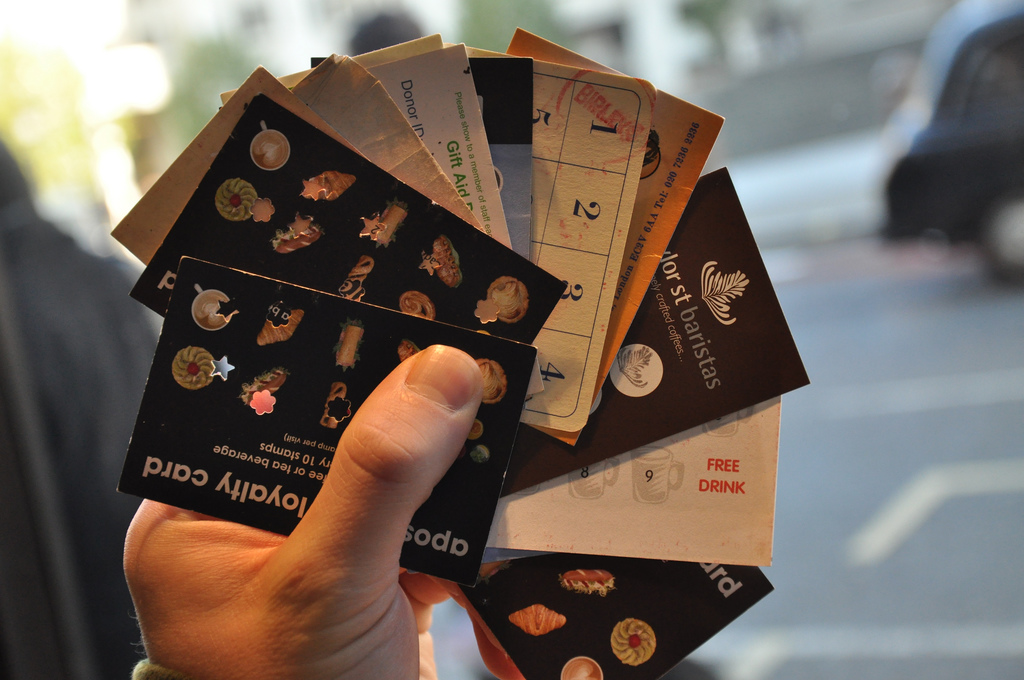
Tag: loyalty

  • Affinity Programs CAN Drive Engagement And Loyalty . . . If Executed Properly

    Affinity Programs CAN Drive Engagement And Loyalty . . . If Executed Properly

    Business owners who sell to consumers are constantly striving to grow their customer base, and to retain the one they have already established. Organic growth, whether driven by effective marketing and promotion or by product quality, or customer service that leads to word-of-mouth referral, is the first priority for most consumer-centric businesses. But most sales pros will tell you that it’s much less expensive to keep your existing customers happy and have them buy more, than it is to acquire new ones. So why are most businesses taking the expensive route, rather than increase retention and engagement of the existing customer base? Most likely, it’s because loyalty programs, or affinity programs that encourage repeat business and customer loyalty, are difficult to execute effectively. There are lots of moving parts, lots of detail to keep track of and account for, and they attempt to codify human behavior and account for each variation to counter potential abuse. This creates other obstacles, which will be addressed shortly.

    Most businesses are good promoters of product, so crafting offers around product, centered on price or volume, is routine and straightforward. Put together a few “Buy one get one free” promotions, or “Early-Bird Specials” to add urgency, and they become your go-to strategy for driving foot traffic (or clicks). It takes little in the way of creativity or customer insight to knock off 10% or split 50-50 for volume purchase, and they do the job to a certain degree. But are you creating real brand loyalty, or just offering casual customers a reason to save a little money?

    Loyalty programs have been around for many years, but the availability of inexpensive computer technology, databases in particular, have spawned a new era of growth for these types of customer engagement set-ups. Sometimes these programs are created in conjunction with other partner businesses – witness the partnership between Giant Food and Shell Oil – grocery purchases are logged and items assigned a point total, and that total yields a discount on gasoline purchases at Shell stations. By linking two basic expenses, groceries and gas, the program allows customers to be rewarded for purchasing things they would normally buy anyway. Credit card “cash-back” programs fill this same need. But, they do engender loyalty.

    But a true loyalty program no only allows for more repeat business from your best customers, it give them a reason to tell others about what a great deal they get from you, thereby expanding your customer base organically without spending a dime. By rewarding the behavior you want -repeat purchase on a consistent and regular basis – you build transaction volume over time and increase profitability. But is this organic growth, or just incentivized interaction? The best loyalty programs no only facilitate repeat purchase, they also encourage referral, and some even provide disincentives for disloyal behavior.

    The very best programs not only engender loyalty, provide an incentive for not only loyalty but referral, and provide a mechanism for it. But they are also very customer centric, which means they are elegantly simple for the customer to enroll in and use regularly. Keytags with bar codes are convenient, but if it takes you half an hour and twenty pieces of personal information to enroll, the abandonment rate will be huge and usage will never meet expectation as a result. Simple for the consumer includes simplicity in enrollment, usage, and in accruing benefits. Credit card points programs are notoriously complex when it comes time to actually reap the benefits of your buying behavior, with many rules, complex formulas, and exceptions to the promised rewards that can make cashing in more difficult than it’s worth. To avoid fraud and abuse, those companies have put the onus on the consumer to do their back-end work for them, and find their own way through the maze of regulations and guidelines. Simpler is better.

    All the loyalty programs in the world won’t overcome product quality issues, poor customer service, bad product design, lack of distribution channels, low awareness or other inherent consumer business issues, but if you have the others conquered, a well thought out loyalty program can be a big help in tipping the scales toward brand loyalty, reducing churn, increasing engagement and retention. As usual in marketing, the secret to success is in the execution . . .

  • Brand Loyalty Is More Fragile Than You Think

    Brand Loyalty Is More Fragile Than You Think

    Marketing and sales pros know that people don’t really buy features and benefits, they buy feelings and stories. Your brand (hopefully) tells your buying audience a compelling story, one that gets retold each time they interact with your brand, which makes them feel a certain way, under a variety of circumstances. For retailers this means that each time customers shop your store, whether brick and mortar or online, they have certain expectations of that experience, and if you don’t live up to them, you may be doing damage to your brand. This makes customer service a key component to brand loyalty.

    I was speaking with a friend of ours the other day and we were comparing the stores where we buy wine. I buy at a small, boutique, one-off adult beverage emporium, one that specializes in having a large selection of micro-brews, and a strong selection of more esoteric Bourbons and Scotches, and a terrific selection of wines from around the world. She shops at a chain store, owned by a major grocery retailer, with a huge inventory of all the top brands, great pricing due to volume buys, and a no-frills approach to store design and displays.

    The reason she was asking me where I buy is because she had recently experienced three separate instances of poor customer service by store sales staff. She swore that after three strikes, she would never patronize that store again. Her brand loyalty to that brand, which had been off-the-charts strong before, based on it’s affiliation with the larger grocery chain, had been eroded to zero in just three perceived poor incidences of inattentive, rude, or unpleasant behavior. The selection, pricing, hours, decor and layout hadn’t changed one bit, but her perception of the store and its contents changed dramatically, for the worse.

    Now I’m pretty sure the large chain won’t really miss her business, and will likely never make positive changes to the sales staff’s training or behavior guidelines, probably because they will never know they have a problem, and she has no reason to tell them about it. But if you multiply her experience by a hundred, or several hundred, or several thousand chain-wide, you start to see some negative effects on the balance sheet. If you disappoint your target audience badly enough, or often enough, then your brand is no longer what it was.

    Ongoing feedback from customers, becoming more customer-centric in your operations as well as your marketing, can help stem this downward spiral and if caught early enough can give you a start on reversing it. Some companies are acutely aware of this, and take great pains to listen carefully to their customers. This customer brand monitoring takes several forms – feedback cards, social media monitoring, ongoing survey research, continual customer service call monitoring and review, and a host of technological solutions that track and measure customer attitude and preferences.

    One of the more diligent brands in this regard is Hilton. They religiously guard their premium brand, listening carefully to all customer feedback, and taking swift, effective steps to satisfy customer complaints. They do it so well that most complainers are turned into brand evangelists! They have an overwhelmingly positive customer rating in a variety of categories by organizations like J.D. Power, Zogby Analytics, and media outlet lists like MSN, List25, and Wall St. 24/7. They have realized that their customer interactions are a driving force in their brand loyalty, and take iron-clad, positive steps to protect it and bolster it with each customer experience they deliver.

    The real message is that while a single customer may not contribute much to your bottom line on their own, the symptoms and actions that lead to that customer losing their loyalty to the brand need to be addressed before they “go viral” among your customers and degrade the brand. As Barney Fife once said, “we can’t have that kind of behavior, we gotta nip it in the bud” when you fail to deliver the highest level customer experience each and every time.

  • When To Give The Customer A Quick In-And-Out

    When To Give The Customer A Quick In-And-Out

    For those of you with less than pure thoughts, got ya! I don’t write on customer service issues very often, once or twice a year, and it usually has to do with how to treat them with respect, how to enhance their experience, or how to engage them more thoroughly and for longer. But sometimes, you just want to get in, get yer stuff and get out, and that’s not always a bad thing.

    The thought of speed in a transaction is a foundation in certain sectors of brick and mortar retail – groceries, convenience, gasoline, and the like for instance. They aren’t large footprint locations, don’t have much room for folks to be roaming around, and studies have shown that they often are in a hurry or have a set list of things they need, and that total receipt won’t change much due to them lingering. They make up for this by providing a lot of opportunities for impulse buying while they have you the most captive – at the cash register. Some of these locations are so ardent about this, that they have arranged the items packed so closely together you can hardly see the cashier for the racks of stuff! But you can still get in, pick up your choices off of easily selectable shelves and quick-grab racks, get in a line (if there even is one) and pay inside of a couple of minutes, seemingly regardless of the number of items.

    In that instance, that’s good customer service – you gave the customer exactly what they wanted – speed. Their expectations were met and you’ve given them exactly what they needed, a no-frills transactional approach to commerce without a lot of fuss or conversation. Some of this is possible due to technology – they have the fastest register software available and the simplest, most common-denominator pricing and indexing for inventory of anyone in the business of retail. But some of it has to do with design, layout, and most importantly, human behavior.

    The reason people shop at convenience stores is exactly that – convenience. They don’t go bargain hunting, they don’t argue over the $3 mini bag of Cheeze Curlz, they don’t bring coupons (there aren’t any), and they often aren’t terribly loyal when it comes to brand. They’ll pay a premium for the speed and won’t argue about it with the cashier, who says as little as possible during the transaction. They’re not folksy, they’re not chatty, they don’t know you most of the time, and don’t plan on seeing you again, ever. No need to form a relationship, just bag the chips and the soft drink and move on.

    That’s not to say that you feel rushed, or hurried, or that the service is brusk or rude, because its not. It’s just devoid of emotion, good, bad, or indifferent. They serve a function, do it well, and please the customer – job done. For the cashier, this is a relatively simple, boring to the point of inanity, potentially dangerous job, often on an odd shift, done for the short-term based on a dearth of marketable skills and a need for capital – it’s not a career position. For the customer, it’s a quick pit stop with a specific purpose, no browsing or emotion required, and if they happen to find something whimsical or amusing at the register, or something there reminds them of another item they need, so much the better for everyone – what the heck, it’s only two bucks, right?

    Other types of retailers can benefit from this approach as well, specifically online. Everyone’s focus in the early days of web commerce was to extend “dwell time” – how long are they lingering on the site, what are they looking at, what page and what item draws their attention, were key metrics. Consumers were still getting used to shopping online, and there had yet to be developed standards of usability or code norms for websites, so the customer had to not only learn how to find the items they were looking for, but how to work the website in order to get them, from the shopping presentation matrix to the sizing and customizing of the item, to calculating the shipping time and cost, to the payments page(s), it was a learning experience, not so much a shopping experience.

    More recently, shoppers have gotten vary familiar with all the bells and whistles of online commerce, web designers have figured out how to present non-static digital items for greatest effect, and how to lay out pages intuitively so that your eye and cursor travels to what you want almost effortlessly. It’s a strong advantage, and only recently have online shoppers been allowed the freedom to use their own data to speed the process along. For commerce sites you frequent, there is significant data from your prior transactions that allows both you and the retailer to benefit.

    I frequent a couple of gift sites for things I send to clients for the holidays, and after a few years, I can visit them, select, buy, address and ship about 20 items in less than 30 minutes – blazing speed compared to a trip to a crowded mall, let alone the gift wrapping, boxing, shipping, and distribution time and cost. All the addresses are already there, my selections from last year and prior are logged, and it reminds me if, in my shopping haze, I duplicate a previous gift – nice feature for us oldsters. The shipping is often either included or free based on frequency and volume, and I know the quality and presentation are top notch with out having to investigate further – a quick in and out transaction that by no means diminishes the thoughtfulness of sending a gift to a loyal client.

    Sometimes providing a great customer experience really means delivering on your brand promise, as long as it’s been accurately telegraphed ahead of time. I know the convenience store doesn’t have premium brands, I know their selection is rather limited to a certain type of merchandise, and I know that I’m not going to get a bargain, or be met at the door and asked if I’d like a sample of Chai latte while I shop, or that the cashier is going to gushingly ask if there’s “anything else she can do for me.” But I also know they’ll have what I need to get by, right now, and get me back out and on the road without having to do anything special, or even say a word. Sometimes, that’s a great experience!

  • Sometimes you want to go . . . where everybody knows your name

    Sometimes you want to go . . . where everybody knows your name

    Everybody wants to be wanted, or at least recognized. I have a few places where they know me on sight when I walk in the door, but that kind of permanence and stability has been rare, especially since I grew up outside the Nation’s Capitol, where there are very few “natives” and the population is extremely transient. Too, I went to a very large university in Boston, where much of the student population was composed of commuters, so the typical school experience was very different, more focused on studying and less on social life, especially after dark, when a majority of the student body left for their own homes in the suburbs.

    Business relationships are often like that, too: you meet, you greet, you follow up, maybe even work on a project or several, and then drift apart. Relationships like anything else have to be nurtured and tended to in order to survive and thrive. The relationship with your customers is just that way. It takes effort to nurture them and to keep customers aware of you and to keep your business top of mind.

    Marketing can do that for you, but it must be sincere, and it must at least appear as much as possible to be PERSONAL. Your customers are humans, whether it’s B-to-B or consumer market, and they deserve to be treated as such. Good marketing, especially direct mail copy, should appear to be written specifically to YOU. That DOESN’T mean you just use the word “you” a lot in the copy – there’s an art to it, and if you’re not feelin’ the art, have a pro write your copy for you – its worth it.

    Customer service is often as simple as answering a question quickly and accurately. It can go as far as going above and beyond and addressing a long-standing problem and turning that complaining customer into an evangelist.

    I was the recipient of some tremendous customer service last night, at a business networking mixer, at the Intercontinental Hotel here in Baltimore. There is one place where they know me when I walk in the door, and this is it. Before I had gotten through the lobby into the bar proper, the top notch bartender, Elizabeth, had my “usual” beverage prepared for me, ready to go without me asking or even looking in her direction.

    Now in reality, I have only been a guest there about 6 times in the last year, but it’s always for the same event, the same time of day and the same day of the week, and our schedules collided on a regular basis – but she took the time and energy to remember after just a few small interactions who I was, what I looked like (winter and summer mind you, no identifying scarf or coat to help) what I liked to drink, and how I liked to get the evening started.

    Terrific! Kudos to Elizabeth for taking the initiative and providing outstanding service – and kudos to Arpad and the staff at the Intercontinental for realizing that sometimes employees need to be empowered to go above and beyond to REALLY please customers, and for allowing them the latitude to do it. I’m sure preparing a drink before the customer asks isn’t in the InterContinental’s policy book, but Elizabeth knew that I would be pleased and she was right. Thank you.

    Write about your good customer experiences here, be glad to pass them along . . .

    Did you find this interesting? If you’d like to read more like this about marketing, customer service, branding or other topics, pick up your copy of “The Marketing Doctor’s Survival Notes”