Tag: investigation

  • Are You Selling To The Right People?

    Are You Selling To The Right People?

    We’re big advocates of using research, especially primary customer research, to drive marketing and sales efforts. It’s much more difficult to miss the target when the target is telling you how to hit it, how far away it is, and where your arrow is in relation to itself.

    Sales benefits as much from research as Marketing does, but in different ways, and by using different pieces of data. Primarily, Sales will be ale to use data to determine who is, and how well-qualified is, the audience of one (company) in front of them. With a list of several hundred prospects in their satchel, Sales people have to determine if this company is even realistically a prospect at this time, who inside that company they should approach, who the actual decision-maker is, and how best to reach out to them to get the warmest reception.

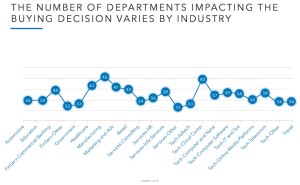
    New research has shown that trying to pinpoint a single individual decision-maker may be a futile and even damaging effort. Corporations are so integrated, so closely cooperative, in an effort to move forward more effectively, to make purchasing of goods and services more streamlined, and maximize cost-effective use of resources, that an average of 3.4 departments get “in on the purchasing decision”.
     

    departments-LG-linkedin-100516


    That number differs depending on the industry, with manufacturing scoring a surprising 4.6 departments needed to make a purchasing decision, and some smaller non-profits scoring a 2.1 or less. Reasons for this are less clear, but the prevailing theory is that the classic manufacturing firm has fewer distributed costs, centralized purchasing for raw materials, and the purchase affects more departments’ budgets and ability to function as a result. Fewer “silos” leads to more people involved in making decisions.

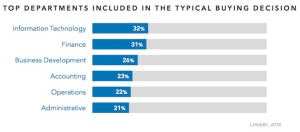
    Which departments are involved makes the picture for Sales even murkier, with variables including cost of the purchase made, length of the sales process, number of touchpoints that selling company has with the target firm, and the nature or structure of the product or service being bought. Things like consulting services, legal assistance, accounting services, tend to have more folks weigh in on the decision, based on the number of departments such an engagement will touch within the company. Things like maintenance and physical plant services typically fall so squarely within Operations, with a touch on accounting and finance, that usually there is only one true decision-maker. The decision to spend the money has more involvement, but the actual vendor is pretty straightforward and stays “local” most of the time.
     

    influence-linkedin-100516


    The bottom line is that sales people need to do a certain amount of probing and due diligence when qualifying prospects to make sure they are not only aware of all the various inputs in the buying decision, but that key stakeholder are not “left out” of the communication chain, to avoid making them feel ignored or worse, disenfranchised. That kind of innocent mistake can torpedo even the most potent sales effort, and it may be happening and you don’t even know it.

    The time spent doing this type of research is almost always time well invested, if for no other reason than to allow the sales person to speak with confidence about the target company. Additionally, it avoids the type of error described above, and allows you to streamline the process and avoid real time-wasters, like selling for months to the wrong person(s).

    This type of information should be prominently noted in your CRM entries as well for each prospect, not only as a reminder to you, but as a signal to others viewing the reports, who may be able to suggest a new approach, or use a contact in a department you have yet to approach. Share the wealth.

    Do your homework, include and approach the “right” people, and be aware that it will likely take a unanimous decision among up to four full departments to close the sale. Knowledge is power in this instance – go forth and be powerful!

  • Keep Your Audience Close . . .

    Keep Your Audience Close . . .

    As a marketer, I have a certain level of curiosity about my client’s customers, and how to reach them effectively, how to reach their emotions, to shift their perceptions, to alter their behavior in a way that helps them make the decision to buy, to join, to attend, to engage in some way. That curiosity is at the heart of all of our engagements, and as a research-based marketing strategy purveyor, we get to indulge that curiosity on behalf of clients every day, and after some discussion realized that we were all grateful for that.

    Knowing your audience thoroughly and as completely as you can is what makes for marketing success. It allows you to speak directly to them in your copy, it allows you to offer them products and services and opportunities that you KNOW they will appreciate and will feel entitled to obtain. Knowing what they like, when they are likely to like or need what you offer, knowing what stage of life they are currently inhabiting, and being able to predict how they will react to a given opportunity allows you to present thing you have to offer in a way that other retailers and marketers can’t touch. Good research will allow you to do that, no matter what you’re selling.

    Many of our engagements involve outreach in the form of direct mail, which allows clients to reach a wide audience with customized offers or pricing or product choices created specifically for that individual or group of individuals, with remarkable success. Mail may seem antiquated in an era of high-speed social media, e-mail marketing, wireless mobile this and that, but really marketing is not about tools, its about connecting with the potential buyer in a way that influences them. It’s about influencing them to consider your products and services for purchase. Purchases make companies money, period. So really, all the online communities, all the digital social interaction, all the sharing of consumer information really doesn’t make anyone any money until someone actually buys something.

    What it can do is help you know your audience better. All the data served up voluntarily on a daily basis can help you frame a profile of your audience that’s more true to life than what magazines they read or what type of car they drive, and certainly provide more recent information. The combination of social media data and transactional data from retailers can be an unbeatable combination for marketers hoping to know their audience better. The data is available, now you have to figure out how to actualize it, to monetize it, to turn data into dollars.

    The more you know about that target segment and the individuals contained within it, the better you can offer them goods and services they will find appealing. If it’s appealing, they will find a reason to buy it. The simple formula goes: data > knowledge > strategic appeal > purchase > data . . . in a big circle. It’s a good formula to keep in mind, and it feeds into the whole idea of creating a community. What makes a community, in marketing parlance, is that you have a group of individuals who have a reason in common to repeatedly participate in a certain activity, be it buying, or discussing, or learning about  or something involving what you have to offer. The “in common” part makes it efficient to reach them and binds them together. The “repeatedly” part is what connects you to the data acquisition formula, and what gives marketers the “in” to offer them things they find appealing over and over again.

    The real moral of the story is that the better you know your audience, the better you can serve them and the better your marketing will be to them, which in turn adds to your ability to serve them. Go forth and gather data . . . you’ll be glad you indulged your curiosity!

    If you found this information valuable, and would like to read more, be sure and pick up your copy of “The Marketing Doctor’s Survival Guide”. . .