Tag: association

  • You’ve Worked Hard To Sign Up Those New Members . . . Now, Keep Them Around

    You’ve Worked Hard To Sign Up Those New Members . . . Now, Keep Them Around

    With the realities of the “new” economy intruding into everyone’s business and personal lives, and the recent political theater further adding to the uncertainty about the future, it’s more important than ever for non-profit organizations to focus on member retention, on devising and living up to that key value proposition that keeps members coming back year after year.

    Based on nearly 100 executive interviews over the last 10 years, we’ve compiled five core activities that seem to keep association members renewing their memberships time and again. Not all five are necessary, or even reasonable together, but by selecting elements that are true to their organization, non-profits can make all that member recruiting work pay off beyond the initial year.

    5) Remind them what they’ve received this year. Renewal notices that list the benefits which that particular member have partaken of during the year is a quick, but effective, way to show the value each has received when it comes time to write the dues check. For those with no transactions on record during the year, defaults could include participation by their voice in aggregate on industry-centric political or regulatory issues, or mention receipt of key information through their magazine or newsletter articles that helped them advance their knowledge or career.

    4) Communicate the message in the media and format they prefer. Hopefully in your member database there’s a field for “preferred communication method” that can be selected. If members have chosen to receive ALL communication from you electronically, make sure they receive at least one renewal notice electronically. As a matter of strategy, you should hit them from several different angles using several media, but make sure the preferred method is first and most prevalent.

    3) Make sure they are actively engaged as soon after enrollment as possible. Studies over the years have backed this assertion that the likelihood of a member renewing beyond the first year directly correlates to their speed and level of active engagement. Invite them to be on a committee, put them on an editorial review board, ask them to attend a seminar for free as an introduction to the organization, have a staffer  phone them and ask what they feel are the most important reasons to join – something to show you know they exist, and that they are welcome at the organization.

    2) Repeatedly restate and reinforce the strong, unique, value proposition your organization represents to them. Show each member how the benefits you offer directly affect their personal or professional life in a positive way. Make it easy for them to walk that renewal notice up the hall to the CFO’s office and show how the value received is worth the dues money you’re asking. Be specific, attach a dollar amount to each benefit if possible – just like when you were in school and were asked to “show your work,” you have to do the math for them, and it has to make sense.

    1) Have recent, solid, professionally-performed research on your particular members, to really know what benefits will resonate with them, and show how those were delivered over the past year. Telling members about benefits they don’t use or care about can actually work against you, making it appear that you are wasting funds on things that don’t matter to the members. This knowledge is critical to creating and implementing that unique value proposition as well as formulating a benefits package that will attract and keep good, loyal members.

    There are many different tactical schemes for boosting retention, at least temporarily, including rate discounts, waivers, hardship grants, and a host of other discounts or special deals, but the most powerful of all is delivering the desired value in a timely, engaging, and directed fashion, year after year. Find out what they want, and give it to them in spades – you members will be as loyal as can be.

    If you found this valuable, and would like to read more, subscribe to this blog, above. Also, don’t forget to pick up your copy of “The Marketing Doctor’s Survival Notes


  • When In Doubt, Do SOMETHING!

    When In Doubt, Do SOMETHING!

    Granite Partners ‘ sole reason for being is to help trade and professional associations excel at what they do, to grow and thrive and move forward confidently in their work of improving their members’ professional and business lives. Many of the engagements we take involve marketing, and one of the most frequent things we’ve been asked to do is essentially play the role of “energizer” for the organization’s marketing efforts.

    They’ve done the same thing year after year, promoted the same conference the same way, recruited the same type of members in the same way for years, and are starting to see their results deteriorate. Their membership numbers are flat, retention is down, conference attendance is dwindling and fragmenting, and the whole organization is struggling as a result of curtailed budgets, reduced momentum, staff ennui, and a general lack of verve for the organization’s mission.

    We come into the organization, review all their efforts, work with senior management and staff to break down some of the reasons why things are done the way they are, maybe slaughter a few sacred cows, generate some ideas for new initiatives going forward, and then work with them to implement them. From 10,000 feet, that’s what our practice looks like. Under the hood, however, there’s a lot more going on. Counteracting all that inertia, brightening up the mission and the message, assessing member’s preferences and needs, researching new member segments, generating program initiatives, all takes time, resrouces and energy. But what it really takes is courage.

    There is often some long-standing doubt surrounding these new initiatives, some deeply-rooted skepticism among the staff, many of whom have been working there for years, and have seen initiatives come and go, to no apparent effect, and don’t expect these to be any different. The courage to change the status quo is difficult to locate and harder to draw out and nurture, to bring to light and expose for all to see, so that it can spread among the staff and be transmitted to the membership. That’s our real job.

    Often what it comes down to is this: Something is better than nothing, so when in doubt, do SOMETHING and we’ll figure out if it worked later. Getting this type of thinking started takes the courage of managers and rank and file alike, and is a cultural anomaly, especially among older employees. Asking forgiveness rather than permission is counter to most Association cultures, build up after years of top-down management and communication, lack of mid-level empowerment, long chains of budgetary approval and micromanagement. Breaking that paradigm (I hate that word, but it actually fits here), is a tough challenge, but the benefits are myriad and multifaceted.

    Marketers in many organizations have been working under this new “Do Something” regime for a while now, and the one’s who pull it off successfully have earned the respect and understanding, and in some cases the admiration, of senior management in their organizations, having proven themselves to be solid, reliable producers, despite what might be seen as the use of unorthodox methodologies. Unfortunately, this new disease is not highly contagious, and needs to be spread deliberately among other staff departments. The courage to take the initiative, to empower the staff to think for themselves, to solve problems pragmatically and immediately, takes time and effort to develop, but the results are unequivocally worth it.

    Do yourself a favor – when your marketing program seems stale, your efforts start to look tired and hackneyed, the results start to droop – DO SOMETHING! You’ll be glad you did.

  • Members Behave Like Consumers . . . and Make Decisions The Same Way!

    Members Behave Like Consumers . . . and Make Decisions The Same Way!

    As the debate rages on as to whether non-profits would be better off behaving more like for-profit corporations, it would be wise to keep in mind that the central reason most non-profits were formed was to serve the members, and in that aspect non-profits could learn a lot from their for-profit counterparts. If you were to substitute the word “member” for “customer” in much of the modern marketing and advertising literature, there is a deep mine of wisdom that non-profits could plumb in order to more adequately frame their value proposition, and find greater success in the ever-present quest to find, recruit, and keep members.

    There is an obvious schism in the way corporations reach out to consumers. The two schools of thought – the “logical” and the “emotional” – are forced to co-exist, and if done properly, can work cooperatively to achieve their goal of building customer base and consumer loyalty. The “Logical” school, promoting features of the products, and the benefits thereof, using statistics, facts, information to make a “case” for their product’s superiority; and the “Emotional” school, in which images and messaging that appeal to some of the more base emotional motivators to influence purchasing behavior appear.

    This can perhaps be seen most readily in the automotive industry, possibly due to the sheer volume of television and print ads for cars that pervade national media. In roughly half the ads, the manufacturers promote things like fuel efficiency, flexibility in seating arrangements, crash safety, popularity with consumers, cargo space, back-up cameras or parking assist, features that make it desirable to certain segments of the buying population. The other half feature imagery and messaging that promote how the car will make you look, feel, how it will make your neighbors envious, how you’ll be more popular or get more attention if you own one, how it will make your co-workers jealous, appealing to the base emotional drivers like need for recognition, elevation of status or popularity, vanity or need for acceptance.

    In nearly all the non-profits we’ve worked with or counseled, the value proposition has been of the “Logical” variety – here’s the benefits you get from joining and staying a member. The other half, and some would say the much more powerful half based on some recent consumer research on buying behavior, has been left out in the cold, as if because they are a professional organization appealing to other professional organizations or persons, there is no emotional reward for becoming a member. This bloodless approach is unfortunately too typical of B-to-B marketing in general, but the ethos surrounding non-profits is so laced with the need to be taken seriously, many cannot bring themselves to voice the benefits of membership in any sort of emotional way for fear of being seen as weak, or needy, or heaven forbid, unprofessional!

    By injecting some of the emotional component into their outreach approach, non-profits could certainly experience great success in their recruiting efforts, as they would find a much larger segment of the buying population would respond to their appeals. Even in a B-to-B purchase decision, there are one or more PEOPLE making that buying decision, people with emotions, feelings and attitudes that can drive behavior in a much stronger way than the typical “Franklin List” of pros versus cons of joining an organization. By taking a “business only” approach, membership marketers have sidestepped a huge driver of consumer behavior – the need to belong, for acceptance, for praise and recognition. Maybe they feel that the emotional appeal may not be strong enough to pry the dues check out of the fingers of hard-nosed business members, who need a business case to justify every decision. Maybe they’re uncomfortable using a more emotionally based appeal to reach their potential members because they can’t guarantee to “deliver” that type of benefit year after year. Whatever the reason, there would seem to be tremendous gains to be made by positioning their organizations emotionally as well as economically.

    Maybe a look at another area of their operation would yield some insights – many non-profit, member-based organizations have a charitable arm or foundation of some sort, and the search for donors is often not only more aggressive and better focused than the member recruitment effort, but the appeals tend to vacillate between the logical and the emotional appeal, doubling the reach of the organization and driving donations beyond what the membership could logically support. Much can be learned from corporate marketing efforts and applied to non-profit recruitment and retention efforts. Sometimes its a case of simply looking over the backyard fence . . .

  • Engagement Turns Your Members Into Cheerleaders

    Engagement Turns Your Members Into Cheerleaders

    Under the traditional membership model employed by the majority of non-profit trade and professional groups, membership in the organization offers you benefits, but doesn’t necessarily deliver them directly to the member. That doesn’t refer to third party affinity programs or insurance underwriters – it refers to the fact that the interaction with the organization is typically voluntary and one-sided. The member has to reach out to take advantage of the particular benefit directly, the organization typically doesn’t drive the benefit to the member. As a result, what often happens is that many of the potential benefits of membership are either unknown, or unused, and as a result, there is not sufficient member engagement to really live up to the value proposition that the initial membership offer proposed.

    Studies have shown that if a member is actively engaged in the activities of the organization, either through staff or another member, their chances of lasting longer than the initial year as a member skyrocket, rising by over 400%. Given the lifetime value of a member to the organization, it would seem a smart investment to craft an engagement program to reach out and grab those new members, get them involved, give them a sense of mission, of empowerment, and of belonging, that will help retain them for years to come.

    Those organizations who do put in the time and effort find they reap fairly substantial rewards at renewal time. Renewal rates above 94% are not uncommon in those organizations we’ve studied, and the members not only rejoin, they go out and recruit as well. That’s a double win for any organization, in an era where time starvation and economic uncertainty make membership a low priority for most professionals. And it doesn’t have to be complicated or automated to show strong returns.

    Sometimes a simple welcome phone call, from a prominent member, Board member, or staffer, to introduce themselves, welcome the new member to the organization, ask some questions, including what they expect to get out of their membership. Not only does that keep staff in touch with members on a programmatic basis, but provides a constant source of research data on the value of offered benefits, and their popularity among the membership, in real time. Not a bad bonus for making a few calls a week.

    Sometimes the effort can be more formal, such as an invitation to join a committee, or to provide feedback on a new product or service prior to it’s introduction to the general membership. Sometimes it’s a request for support for a cause, lobbying effort or legislative initiative. The key is to do it early, and in a systematic way so that no one falls between the cracks. More elaborate efforts will incorporate timing features, automated systems to reach out to certain sectors on a rotating basis with a specific focus, and other bells and whistles, but those automated systems tend to dilute the impact of the effort, to depersonalize it and distance the group from the new member, the exact opposite effect of what you were seeking. The simplest and most effective is the most honest and direct method, a personal phone call or letter from an known member of prominence, welcoming them to the organization, asking what they need or expect, and helping them take direct advantage of the benefits the group offers.

    Engagement can take many forms, and the right form is different for each individual, as different as their real reason for joining. Once such a program is in place in your organization, you’ll be amazed at the increase in retention, engagement, and connectivity of your members. They wanted to be a part of a group for a good, real, reason. Tap into that need, and you’ll have a group of lifetime members who closely affiliate and identify with your mission – they become cheerleaders, and that’s where the gold is!

  • Win With A Member-Focused Value Proposition

    Win With A Member-Focused Value Proposition

    Readers – Melynn and Carol have really laid it out for us so well I felt no need to add anything beyond “kudos” – we’ve been telling our association clients to research their members’ needs and desires to drive creation of effective benefits, and generate a reasonable value proposition for acquisition and retention for years – clearly these two marketers “get it” –  let me know what you think.

    By: Melynn Sight and Carol Weinrich Helse

    Summary: Develop a strategy based on your members’ wants and needs, and your association will deliver the most relevant suite of products and services to them, leading to higher membership numbers and greater engagement.

    While most association board members think they know what association members want, there tends to be an unintentional disconnect between what the board members believe they know and what association members actually want. Volunteer leaders and executives tend to focus on membership benefits, not the value proposition. In doing so, the association loses an important opportunity to articulate what is really important to members and what will ensure that those dues checks keep coming.

    Thinking about value from the outside in—starting with what members worry most about—will help leaders begin to think, plan for, talk about, deliver, and promote the most relevant portfolio of services.

    What is a Value Proposition?

    10 Steps to Develop and Launch a Value Proposition
    1. Gain approval. When leadership considers this a strategic initiative, it will fuel the process from development through implementation.2. Determine if you’ll do the project yourself or if you’ll hire a third party.3. Do your research. Assemble a diverse task force of members to help plan with “the voice of the member” in mind.

    4. Identify up to three important member audiences.

    5. Determine the biggest concerns and needs of these three member audiences.

    6. Create a draft of your value proposition based on how your association currently answers the biggest needs of these three segments.

    7. Present drafts (or recommendations) to your board for approval. Finalize the value proposition and proof points that support it.

    8. Develop a communications and launch plan for your value proposition. Use the value proposition in association marketing materials, on the website, and in your CEO’s talking points. In other words, make it visible.

    9. Execute on your value proposition. Consider how to incorporate the value proposition into strategic planning, committee work, and staff operations.

    10. Survey and ask members for feedback to determine if you are making progress. Report measurements back to the board along the way.

    A value proposition offers members a clear, sound rationale for joining, belonging, contributing, and taking advantage of what your association offers them—starting with what they think is valuable. It differentiates why a member chooses to belong to your organization, a competing organization, or none at all.

    Developing a value proposition is a multi-step process that will aide in organizational planning and membership growth and loyalty. The outcome is a clear, direct claim that is relevant to your important audiences and represents what your association does well today. The written proposition is a statement that helps tell your story of relevance in a concise messaging platform that becomes the basis for all your association’s communications.

    What’s Your Problem?

    Early in the process, be clear about the reason why you need a value proposition in the first place. Some associations say they need one to unify their staff; others know how much they offer members but need a clear, simple way to articulate it. With the specific motivation for your work, you can keep your focus on the goal throughout the process.

    Leaders are increasingly seeing value propositions as the most meaningful step toward building and sustaining association membership. A well-researched and crafted proposition guides strategic planning, staff communications, and gives a purposeful approach to committee work.

    Recognizing your members’ needs first and then purposefully feeding those needs into your association’s strategic work can be a radical shift in thinking. This change in perspective can help organizations rethink how they plan, organize, and set goals.

    Invest in the Process

    A value-proposition project is not a simple one. Ideally it includes a task force composed of a diverse group of members who will devote a significant amount of time to the process. Task force members must clearly understand their role as well as the definition of a value proposition. The association’s executive director should be involved in facilitating board awareness before, during, and after the project.

    The most relevant value proposition projects begin with a member survey to uncover issues members worry most about, what members value, and how satisfied they are about the areas that are most important to them. Satisfaction with the wrong offerings is an unproductive way to run an association.

    The value proposition process requires investment. Whether you do it yourself or outsource it, you must invest manpower, energy, and money to develop the proposition and collateral to communicate it. Then it takes energy and focus to communicate and sustain your claims if you want to affect change.

    A Change in View

    A clear, concise value proposition will change the way your association approaches its business. A credible value proposition forces you to evaluate your services and communications with members with a benchmark that is set by them. It also pushes you to make internal decisions from the members’ point of view. This is a significant shift for many organizations and one that can create some meaningful dialog about current and new services. Are the services and activities that you offer today clearly ones that mean the most to your members? This can create conflict with programs that are sacred cows. Embrace the new view and overcome the conflict, and your value proposition will lead to stronger programs, more effective committee outcomes, and higher member satisfaction.

    Now is the time to begin this process so that you’ll have more members writing next year’s membership checks.

  • Association Member Engagement Mountain

    Association Member Engagement Mountain

    Written by Dan Varroney

     Dan at Potomac Consulting has hit this right on the head, we fully believe and recommend to clients that the engagement puzzle be solved so that true growth can be achieved that is sustainable and manageable, not just a quick promotional bump in the numbers. This shows why . . .

    It’s important that in this day and age that Associations not “leave well enough alone.” The Stay or Go Imperative could impact an Association’s financial health and well being. If membership is a distraction instead of ROI, Corporations vote with their feet and instead invest in a different solution.

    Yes,  Corporations have smaller corporate staff, in some instances one executive may wear multiple hats. However, if this executive makes the dues decision, then a strategy or a change is  necessary.

    Read the Tea Leaves

    Companies look for the connection to business objectives as part of their membership evaluation process. If these connections don’t exist, it’s difficult for any Association to execute an effective strategy to engage members. Metrics are like tea leaves they both paint a picture and they tell a story.

    If Associations observe that conference attendance is equal or less to prior years, educational meetings and fly-in attendance is significantly lower, and member retention is down for three consecutive years,  it is time for an intervention. The marketplace could also signal one or more of the following: 

    • Negative view of the culture and overall effectiveness of an Association.
    • The Association is perceived as not being as impactful in educational, policy or advocacy programs.
    • Other solutions including coalitions, conference providers or other Association programs deliver greater value.

    Never Hit The Panic Button

    Associations should embrace the challenge and convert the situation into a strategic opportunity. When diagnosing, member participation and revenue fall-off rebuild the path to engagement: one company at a time, obtain clarity on business and policy objectives, and understand what members really must achieve from participation achieve.

    CEO’s can keep in mind that success and failure are never final, the road forward offers hope, and a more definitive path to member engagement.

    Develop Data Driven Strategies

    Associations need to build a data set to help them understand why participation and revenues have fallen.  However, it’s key to put heavier weight on relationships; in a complex world the human connection matters. One member at a time, collect the following information:

    • Is the Association perceived as staff or member driven?
    • Does participation help executives achieve company business objectives?
    • Why do executives participate in other Associations or Coalitions?
    • How important is networking?
    • Would Social Media engagement on platforms such as LinkedIn reflect an attractive alternative?
    • Are educational and or certification programs relevant to career advancement?

    While Associations may develop additional or different questions, these open the door to constructive dialogue with disengaged members. Tally the responses, create internal task forces of senior managers and key staff, develop solutions and new strategies, assign performance metrics and then execute.

    Association Member Engagement Mountain

    For Association CEO’s who have or who are looking into the abyss, there is light at the end of the tunnel. An Association Executive confronting the worst dues loss in decades once reported record gains in member participation, advocacy effectiveness and revenue growth. Stepping back, building an Association wide member focus with data driven strategies proved to be a year long process worthy of the effort.

    Yes, the participation, retention and growth outcomes were record highs but the data really reflected stronger member connectivity.

    Climbing the Member Engagement Mountain is vital and necessary for every Association. It can also be the determining strategy helping Associations achieve revenue growth.

    How does your Association drive Member Engagement?

  • Professional Membership Has Great Value for the Member and the Organization

    Professional Membership Has Great Value for the Member and the Organization

    The new revolution of Social Media and its marketing potential has been one of the most heavily written about topics in recent years. The success of Twitter, Facebook, LinkedIn and a host of others has been postulated to stem from a need for human interaction in an increasingly isolating world. Is it really a cure, or is it another contributor to that isolation?

    There are some obvious drawbacks to the use of social media, including the threat of loss of privacy; the anonymous and random nature of the “friend” phenomenon; and the fact that there are a huge number of valuable, brilliant people in the world who have no concept of these systems and don’t participate in them at all, and likely never will. They are too busy leading real, enriching, empowered lives outside the cyber realm, interacting with people face-to-face.

    Social media is more likely a ready replacement for the old-fashioned method of meeting new people, seeking out like individuals with common interests, traits, social circumstances and desires – networking events. Meetings, conferences, charities, and professional and business trade associations were the centers of the business and social universe. Members joined to meet new people, those of similar interest to their own. They were from similar backgrounds, similar socioeconomic circumstances, (mildly) similar income and often depending upon the type of organization, geographically similar. They were by definition, a group.

    Some groups are more social than others. Neighborhood associations, fraternal and community, civic organizations, like Optimists, Rotary Clubs, Shriners, Civitans, Elks Lodges, Oddfellows, Masons and such are often built around a charity or fundraising for a specific cause or issue, but are largely social in nature. Professional and trade associations are more businesslike, especially the latter, which has corporations as members, but uses individuals as volunteers. However there are strong social components, including an annual meeting, sometimes a secondary meeting focused on specific components of their industry, continuing education opportunities throughout the year, and of course committee work and volunteer projects to recruit new members, maintain dues and enrollment renewal, and other fundraising projects to keep the organization running and viable. One of the truly valuable benefits to belonging to such an organization is this social component, and the benefits are myriad.

    To form true business relationships, one must find familiarity and common ground. One way to do that is through such business-related organizations where some of the screening has already been done and the common interest is displayed up front. One such organization whose reason for being is to help promote this type of professional interaction is Sales and Marketing Executives International (SMEI). It is a 74-year-old international group with 10,000 members in 30 countries and throughout the United States, whose sole reason for joining is to meet other top business professionals in their sector and enhance their professional knowledge and standing. SMEI offers a certification program for Sales, one for Marketing, and a Management certificate, recognized internationally as a sign of professionalism and excellence. Meeting frequency and purpose varies by chapter, but all have a business relationship-forming function of some sort, based on five founding principles: Professional Standards and Identification, Continuing Education, Sharing Knowledge, Assist Students, Support the Free Enterprise System. Benefits of membership include professional recognition and respect, enlarged professional sphere of influence, strong professional network and enhanced community and professional outreach.

    Those benefits mirror many other organizations’ benefits, but few are stated so clearly and succinctly, and lived by the membership so obviously. Not only does the individual member benefit to a great degree from their participation, but the organization benefits from the aggregate efforts of professionals at this level, working on their projects in their “native” turf – sales and marketing. This is true of few organizations of this type – typically the officers are elected based on popularity first and competence second or beyond. They may have an accountant as treasurer if they’re lucky, or an attorney as President for a year or more, but that’s often the extent of it.

    Professional trade associations with professional staff’s who specialize in Association management are an entirely different animal. These organizations are typically well-run, offer great benefits to their corporate or individual members, the principal of which varies from group to group, but usually include some sort of government lobbying and public marketing for the industry, education of the industry, standards and practices for the industry, statistics for the industry, and occasionally innovation and regulation within the industry. The social component as an adjunct to those benefits comes in the form of an annual meeting, some sort of recognition for outstanding performance within the group or industry, a commercial exhibition of some sort, continuing education opportunities, and networking as a byproduct of all of the above.

    The most important thing you can do to build your personal and professional reputation is to be active in your own industry, and that means joining and most importantly engaging in activities sponsored and structured by your industry associations. Find a way to justify the value of your dues payment, and the easiest way to do that is to get involved – this is truly an environment where you reap what you sow. Join a committee, work your way onto the board, pick a project and give it some time, effort and commitment – new business and an expanded sphere of influence are the smallest possible returns, and those are valuable indeed.

    Based on these types of organizations, the electronic version doesn’t even come close to the power of a personally interacted business relationship. Human beings sense elements of each other’s personality through a number of different channels, including the interpretation of body language, clothing choice, vocal inflection and word choice. Interaction with others on a face-to-face basis is essential to forming fully informed business relationships. All that meta information is lost in the cyber realm, leaving you with just the filtered choices of text and images to work with when forming conclusions about this person’s character, intent and sincerity.

    The next time you’re filing your friends on Facebook, or counting your connections on LinkedIn, ask yourself if you’d associate personally or professionally with all of those people if it meant meeting them face-to-face in a professional or social situation. Would you invite them into your home, meet them at a local hotel for dinner, recommend them for a job, refer them to your banker or broker? If the answer to any of these is no, are they really productive, solid, reciprocal relationships that foster business, or are they more like artificially garnered acquaintances that know more about you than you might like?

    If you found this valuable and thought-provoking, don’t forget to pick up your copy of “The Marketing Doctor’s Survival Notes”

  • How to Assess and Enhance Membership Value

    How to Assess and Enhance Membership Value

    There are many areas of common interest among member-based organizations, especially now, but the largest and longest running area of concern is certainly finding and keeping members for the long term. Its the bread and butter, the engine of any organization, forming the reason for being, driving strategic direction, drawing stable revenue, and creating the nucleus of the organization that gives it its ideological center. But how do you present that value proposition to both new and existing members in a way that keeps them engaged and involved, year after year?

    It is a question that is raised constantly in roundtable discussions among non-profit executives, and one we see in our practice perennially, as new budgets are set, statistics from the prior year are examined and goals are derived. Unfortunately, there is no single easy answer, as each organization has its own unique value proposition, its own character based on the membership in aggregate, and each should be assessed on a case-by-case basis. Fortunately, there are some common areas that can be reviewed and measured, and some relatively easy fixes that can be put in place at minimal cost that will yield results both short and long term.

    The most obvious area in which to start your retention effort is an investigation into what you really know about your members. Almost to a man, if you interview senior executives at a non-profit, they will tell you know they “know” their members well, know what they want and what they need, what will attract them to the organization. Yet if you delve a little deeper, ask when they last surveyed their members about the organization itself, about how their individual lives and businesses have changed, how their needs have shifted, how they’d like to receive information, you’ll almost invariably find that the executives view and the reality do not connect completely. There’s general agreement, surely, for any good Executive Director knows the basics of their members and their respective businesses. However, the speed with which things change, not only in the members’ lives and business circumstances, but in the media and communications arena, regarding content delivery and outreach methods, make it necessary to accelerate your rate of member surveys and research by nearly double the typical rate, in order to stay current. Flexibility and adaptation are the keys to survival, and to make the right moves, you have to have good recent data.

    [pullquote align=”left or right”]…each organization has its own unique value proposition, its own character based on the membership in aggregate, and each should be assessed on a case-by-case basis.[/pullquote]

    Once you’ve decided to craft an updated survey, creating the most revealing questions, limiting them in number and complexity to reduce abandonment and boost response, and deciding the most reasonable and appropriate delivery method are some issues that must be dealt with. There is a balance that must be struck between gathering a comprehensive data set, and gathering enough responses to make the resulting data statistically significant. Too few questions and too little data and its a wasted effort. Too long a survey to get the most data yields too few responses and the reliability of the data suffers.

    Most surveys on a single issue or two are kept to ten questions to boost response. More in-depth total member surveys can be double or triple that, but at that length, delivery methods must be considered, as does the question of incentives. A short survey can be delivered in an e-mail, posted on a website, or set up via an independent web-based services, like Zoomerang. Longer, multi-page surveys don’t pull as well using online methods, and the incentives typically delivered through online surveys, including coupons and links to other sites etc, are typically not powerful enough to drive the response levels you’ll need to make good decisions. The abandonment rate is too high on a long online survey, and you might burn a bridge to your members or customers if you insist on delivering such a document in this manner. More lengthy surveys are often best delivered by old-fashioned snail mail, and include a more valuable incentive to spur response.

    Your list of recipients is also important. It may seem obvious that you include all current members on such a survey, to get a sizable enough number of responses, but there are other constituents that should also receive a survey, and in some cases the questions should be tailored to their status. Expired members who didn’t renew, those in arrears, a sampling of prospects, those with no participation in a committee, project or who haven’t  purchased anything from the organization in over two years, each should have a slightly different coded survey, one that collects information about the value to the organization, their current business situation, and their needs and preferences.

    [pullquote align=”left or right”]There is a balance that must be struck between gathering a comprehensive data set, and gathering enough responses to make the resulting data statistically significant.[/pullquote]

    Once these issues are worked out, the survey delivered and the data collected, the results should be analyzed in a number of different ways. With no baseline data to work from if this is the first comprehensive survey in more than two years, this data constitutes the best information you have, but won’t be useful in spotting trends or sensing shifts in perception or preferences. It can still be used to craft strategy and policy, and to present enticing value to current and future members.

    One of the more important questions is one regarding communications preferences. If you are trying to communicate value to your members, you have to have a good idea how they’d like to receive that information. This question will also give you a secondary reading on the technology adoption curve location of your members. If a majority of members would prefer e-mail or other web-based vehicles, your members are moving toward the center of the electronic media adoption curve, and is a good indication that they will continue to develop at a pace commensurate with the national average. This metric may correlate well to the average age of your member. Older members are typically behind the curve, both due to lack comfort and educational opportunity, and to the expense associated with high-speed internet access.

    Any way you conduct the research, the best policy is to BELIEVE THE DATA. If you’ve gone to the trouble and expense of polling your members and associated constituents as to their needs and preferences, you should at least have faith in the data. If the data goes against your “gut” feeling about members, or trends away from the direction you suspected through anecdotal evidence, it may have been too long since these impressions were formed.

    If you found this article valuable and informative, don’t forget to pick up your copy of “The Marketing Doctor’s Survival Notes

  • “Relevance” The Only Buzz-word Still Relevant

    “Relevance” The Only Buzz-word Still Relevant

    Recently we were conducting some research for an association client, consisting of some preliminary phone group conversations with some of the Association’s volunteer leadership. The group had been furnished with some thought-provoking questions prior to the call, to sort of prime the pump so to speak, and they were very forthcoming and vocal on the call. Their answers and level of discussion revealed their passion not only for their industry and chosen profession, but for their association and their desire to see it grow and serve the needs of the industry.

    As the call progressed, as in most such conference calls, several of the 8 or so voices started to monopolize the conversation, but as they were providing some solid insights, I let the discussion roll on in this fashion for a few moments. All of a sudden, one of the participants, who we hadn’t heard from for more than a couple of monosyllabic agreements since the beginning of the call piped up with a long, eloquent, involved response to a piece of the discussion – the questions had gotten around to something RELEVANT to her, and she jumped in immediately to contribute.

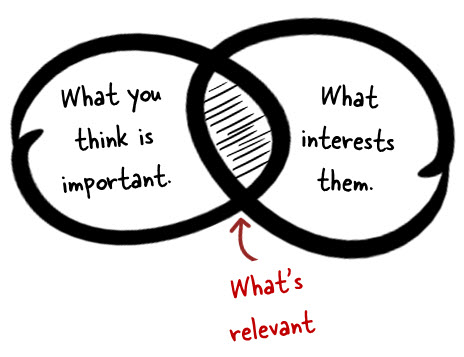
    As I thought back on the call later in going over my notes, I noticed something in the transcripts. These leading members of this group had used the word “relevant” in their discussion of their wants and needs regarding the association no less than 20 times in a 90 minute call! Clearly, they were calling for the association to pay attention to them and to offer something they found valuable, that they could use to improve their work, status or professionalism. In reviewing our earlier work with other organizations, it became clear that many of them have a sector of their constituency that gets short shrift in the overall scheme of things. In our experience, the cry for relevancy becomes louder the more homogeneous your group becomes, and the minority becomes smaller as a part of the whole.

    For organizations serving a diverse population, the need to take into account multiple points of view, diverse needs, forces them to think more broadly, to offer benefits that fit a wide range of sub-sector’s needs. When the group becomes more homogeneous and a small group stands off to the side, it becomes less and less cost-efficient to serve them with their own set of benefits and offers, to serve them in a way they are used to being served. This type of behavior is often a precursor to an association splitting into smaller, splinter groups, each with diverging needs and desires and expectations.

    In short, the benefits offered the majority have failed to continue to be relevant to the minority group. Chances are, the main group’s marketing efforts reflect this, and if not corrected they will start to see participation, purchase response, renewal rates, and all the other touchpoints they measure decline for this one small group. This lack of relevance can drive the entire organization into a negative spiral if not caught early and rectified.

    So how do you fix the lack of relevance? In a word, research. Most organizations will tell you that “they know their members very well”. It has been our experience that the more they say they know their members, the more they live by that assumption, and the less they really know the membership’s needs, wants and preferences. This particular blindness seems to afflict trade groups more so than membership societies, but it applies to both.

    If you want to know what your members really think of you, and your products and services, ASK THEM! You’d be surprised how readily they will offer their opinions, how honest they will be under the right circumstances, and often how simple their needs are to meet. Once their inputs are incorporated into the organizations behavior, the association will start to experience much higher total lifetime values across the overall membership, much better renewal rates, much less cost to keep members, much less spent on recruitment marketing, and that effect trickles down through almost all aspects of your organization, creating much better fiscal health and well-being throughout.

    Organizations that regularly and routinely poll their memberships, that ask intelligent, probing questions, in order to spot shifts in perceptions, identify under-served areas, failing programs, and budding successes, will predictably do much better then those who feel that surveys and other research are “invasive” or “irritating” to the members, and only survey them once every couple of years with the same routine and detached questions. Get to know your membership segments for real, reliably and recently, and use the knowledge to shape your education programs, to craft your conference offerings, to guide your tradeshow approaches and themes, to guide your publications’ editorial calendars, to adjust your website, to shift your media selection for outreach, and you’ll be amazed how much more “relevant” you are to the membership – even the smallest segment you have!

    If you found this post insightful or helpful, and you’d like to read more, subscribe to this blog above – and don’t forget to pick up your copy of “The Marketing Doctor’s Survival Notes”


  • Brand Effectiveness Key to Membership Growth, Part II

    Brand Effectiveness Key to Membership Growth, Part II

    Here’s part II of yesterday’s post . . .

    Brand Effectiveness Key to Membership Growth – Part 2

    In Part One, we discussed using in-depth member survey work to boost the visibility, awareness and effectiveness of your organization’s brand, and how it can directly impact your ability to recruit and retain members. If your organization isn’t the first thing member prospects think of when they turn to industry issues, there’s work to be done.

    Your survey may provide mixed results that don’t show a clear direction. Often this is an indication that there is a disconnect between the brand you put out to the external world, and the one you use to craft the questions! That alone tells you something, and a series of follow-up interviews with the same basic set of queries to the external and internal groups should help clear up the discrepancy.

    Other sources of data can help you check your brand effectiveness as well. Interviews with those alternate stake holders should be couched slightly differently, and can use more “insider jargon” in the questions, as their awareness starts off at a higher level. They can give you a median read, between the internal and the external, and this can often help you reconcile the disparate results mentioned above.

    Take Stock

    An inventory can be helpful in analyzing your brand’s effectiveness. Simply create a list of all the places where your brand appears, in what context, what medium, attached to what product, message or outreach vehicle, and see if they seem to have an obvious pattern, if they are aligned. Often pulling samples from the archives and lining them all up together can be very enlightening. You may be unaware of a brand shift that may have occurred over time, small miscues that send a less the consolidated message to the recipient. One example of this is when an outsource vendor or contractor uses your brand in their program, and it doesn’t match your normal set of brand characteristics. If you are seen as a very sophisticated, august and professionally ethical branded organization, and an outsider puts your logo as a sponsor on a ticket giveaway coupon for a concert, that would be a brand slip or miscue. If several of these items have crept into your inventory, it may be time to put some tighter controls on the use of your brand, and provide some increased education within the organization about the importance of protecting the brand and how to use it properly.

    Top of Mind

    Keeping memorability high is another positive effect of a well –aligned and effective brand. If your brand is consistent with individual experience, that experience will be more memorable. L.L. Bean shows a great example of this. Their “Return any time, no questions asked” return policy has been with them since virtually the beginning of the company. They were so confident in the quality of their products, they couldn’t dream of anyone sending them back, and thus the perceived risk of such a policy was low. That policy became part of their brand, and is now a deeply embedded positive characteristic, so much so that there was near revolt when a senior staffer proposed eliminating it to help save money. As it turns out, their return rate is notably lower than their competitors, and the savings realized would have been more than offset by the damage to their brand as a trusted, honorable retailer of fine outdoor merchandise. As a result, when you get an L. L. Bean catalog in the mail, you instantly put in the back of your mind that the purchase from there is of lower risk, and therefore a greater possibility, as a result of that policy. That gives them a competitive advantage, and keeps their customer retention high and their loyalty even higher, due to the memorability of that policy.

    Brands Aren’t Built In A Day

    If you’ve launched a new product, are a new organization or subgroup within a larger organization, you know the difficulty of setting the stage for a lasting brand. It takes many, many customer touches to build a brand effectively, and with non-profit, member driven organizations, the rate of touch is often affected by budgetary constraints. That puts the building process on the slow track, as the mailings, e-mails, directories, guides, meetings and other activities slowly mount up in the member’s mind. Each piece of the building process must be consistent, and have relevance and meaning for the recipient, or you undo much of the positive work up until then. Be patient. It can take years for an organization to reach a highly memorable, effective state with its brand, and many a good program has been discontinued by impatient senior staffers with a more cautious eye on the bottom line than knowledge of the branding process and its benefits.

    If your brand message aligns with expectations, your touch rate is predictable and rising, and your organization has shown relevance for the audience it wishes to serve, you’re on your way to a highly effective brand.

    If you’re concerned about your brand’s health, effectiveness or strength, and would like to take advantage of our expertise on these topics, be sure and subscribe to this blog, and pick up a copy of “The Marketing Doctor’s Survival Notes”