Category: Vision

  • Building Your Team – Looking for Folks Who Aren’t You

    Building Your Team – Looking for Folks Who Aren’t You

    There comes a time in most working professionals life when they are tasked with something significant and asked to create or build a team to tackle it. For some of us, this can resemble the team-picking exercise we all got through on the school yard for kickball – with predictable results: poor cohesiveness, bad management skills applied inexpertly, a lack of motivation and poor morale. In short, the project sometimes gets done, usually by the strongest or most domineering two or three, leaving the rest feeling disenfranchised or segregated, negated or worse, and a less than optimal project outcome as well. This is not a recipe for greatness.

    Those who take a more strategic approach sometimes fare better, but not always. Those who look good on paper, and have incredible skill sets and diligence to spare, may not work well with others, may not mesh with the overall “gears” of the group, may not parse out their skills in a way that the team appreciates. The results are similar to the above, but with bigger egos.

                  Really good teams at their root have a level of respect for the challenge . . .

    A recent view of the movie “Moneyball” reveals that business is not the only discipline where emotionally selecting co-workers can have negative consequences, but that even things that look good on paper may not work well in real life. It also illuminates the fact that there is a hidden “something” that all winning teams have that all the statistical analysis, investigative scouting, referral burnishing or other team-selection method will not reveal. There’s a certain “chemistry” among winning teams that is difficult to duplicate, harder to engineer or manufacture.

    One way to set the stage for this “Chemistry” is to find individuals with complimentary skills, and personalities, and just enough commonality to let each be comfortable. Six big ego type A personalities banging around in there is likely to be a disaster, just as five or six introspective, analytical introverts. But two or three of each, with a couple of “neutrals” to referee and act as the voice of reason, and things start to look more productive. Sometimes pushing everyone outside their comfort zone has positive results, because the “adversity” acts like a bonding catalyst, sets up an “Us vs Them” mentality that motivates, coalesces, and helps the normally divergent skills and personalities converge to solve the challenge at hand, just to prove they can.

    Really good teams at their root have a level of respect for the challenge and for each of the members that keeps things moving forward and fosters trust. The more difficult the challenge, and the more exclusive the team, the better this works. Setting the stage for this starts with the team’s nominal leader, showing an even-handed, rational and realistic approach to how they handle the others.

    Team-building has to be looked at from many different angles and good ones are effective on several levels. A group of professionals who respect each other and each others’ talents and skills, and who also spend off time as friends, is a rare combination but can be a very effective one. There’s a certain element of vulnerability that helps cement things a bit more closely when you’ve seen the other team members let their hair down a bit and you do the same, put yourself out there a bit and show another side of yourself – let them in, and have them let each other in, and that’s where the “magic” seems to start.

                 . . . the “adversity” acts like a bonding catalyst, sets up an “Us vs Them” mentality that motivates, coalesces, and helps the normally divergent skills and personalities converge . . .

    If you found this interesting and valuable, and would like to read more, subscribe to this blog above and more like this will be delivered to your inbox weekly – and don’t forget to pick up your copy of “The Marketing Doctor’s Survival Notes” 


  • Just Like Rodney, Marketers Get No Respect . . .

    Just Like Rodney, Marketers Get No Respect . . .

    I’ve been reading and absorbing a lot of chatter about the level of respect marketing professionals get (or don’t get) in companies across the nation. There is some debate as to how to justify and validate the need for such positions as CMO, Marketing Director and Marketing Manager – debates that tend to ignore the elephant in the room. The bottom line in most of these discussions is that if nothing is bought or sold, then there really is no “business”, and that without the skill of folks internally in a marketing capacity, regardless of title, no one would be aware that the potential for commerce with your business exists, and therefore no transactions could occur. So based on that logic, without marketing, there is no business. Yet, there is an ongoing debate as to why such people are needed, and what their value to the organization might be.

    Why is this?

    Is it because the rank and file are jealous that the marketing people seem to have all the fun – planning and attending big events, creating collateral, going on photo shoots, speaking with media editors and television stations, creating commercials, and the like?

    Is it because other employees think they could do the marketers job, it doesn’t look too hard and they have fun, so why can’t I contribute to that?

    Is it because with so many marketers out there, there must be a reason everybody picks that, it must be easy?

    Is it because they have a larger budget to work with, and sometimes a larger staff over which to divide the work?

    I’ve heard all of these postulated in one form or another, and many others as well. I’ve sat in meetings where senior executives questioned the efficacy of the entire marketing department’s efforts in the face of 10-20% business growth directly tied to specific campaigns! When the economy slows, such complaints often rise in volume and stridency. Apparently a rising tide floats all boats, but when the waters recede, the marketers that made the boat and kept it afloat are no longer effective . . .

    As marketers, it is our job to facilitate contact and commerce from without the company by working from within the company. There needs to be a belief that an investment in marketing activity drives commerce far in excess of it’s cost, and that beyond that, criticism of the mechanisms employed and the means brought to bear are so much sturm and drang from naysayers. If a culture of marketing is formed and supported at the top of the organization, and communication of those efforts within the organization is fast, accurate and appropriate, that culture will flourish and all members of the company will prosper.

    So, how do we spread the word of such simplicity, and earn the respect we deserve as facilitators of transactional commerce?

    1) Do the job well, and get results that can be measured and proven.

    2) Stop worrying about who gets credit, or blame, and focus on results.

    3) Closely tie effort to results, and promote those results in reasonable, detached fashion – leave the ego out, and just state the facts without the superlatives.

    4) Drive the volume of effort upward – not all ideas are good ones, and not all executions are perfect. But the more you attempt, the more likely one will be a success.

    5) Innovate new ways of thinking and doing that drive success. Open your mind to input from unusual quarters, and give it it’s due diligence. You never know where the next great idea will come from.

    6) Show that the work you perform every day has value to the entire company, that everybody wins when marketing is effective.

    When sales slow down and the economy contracts, many companies go into “emergency” mode, cutting costs, laying off workers, creating an environment of fear and uncertainty, and delaying or outright removing opportunities for innovation – exactly the wrong reaction in a crisis. Many companies have been operating this way since mid-2008, and after six years the fear has turned to something else, killing creativity, halting innovation, and limiting possibilities for success.

    This presents an excellent opportunity for the marketing department to shine! Teach the others how to do more with less – we do it every day! Show others how to think and work your way out of a problem – we do it hourly! Tell others how to prime your thinking to view situations rationally with an eye toward exploitable opportunity – we do that constantly!

    Give away the benefits of your talents as a marketer, and the respect you deserve will return to you ten-fold – that’s a heck of an ROI in anyone’s book.

  • Web redesign to meet actual customer needs boosts traffic 94%! Here’s how . . .

    Web redesign to meet actual customer needs boosts traffic 94%! Here’s how . . .

    Thought You’d Enjoy This . . .

    There’s high competition in higher education. Every day, thousands of colleges and universities go head-to-head, vying for prospective students’ enrollments. For today’s digitally savvy youth, school websites must be on their “A” game.

    “For the vast majority of institutions, it’s your No. 1 communication tool,” said Molly Honan, Associate Vice President of Marketing and Communications, Emmanuel College.

    Learn how Emmanuel College’s team collaborated with students and faculty to fuel a website redesign that upped campus visits and deposits while boosting mobile traffic 94%.

    Read the Rest . . .

  • “Relevance” The Only Buzz-word Still Relevant

    “Relevance” The Only Buzz-word Still Relevant

    Recently we were conducting some research for an association client, consisting of some preliminary phone group conversations with some of the Association’s volunteer leadership. The group had been furnished with some thought-provoking questions prior to the call, to sort of prime the pump so to speak, and they were very forthcoming and vocal on the call. Their answers and level of discussion revealed their passion not only for their industry and chosen profession, but for their association and their desire to see it grow and serve the needs of the industry.

    As the call progressed, as in most such conference calls, several of the 8 or so voices started to monopolize the conversation, but as they were providing some solid insights, I let the discussion roll on in this fashion for a few moments. All of a sudden, one of the participants, who we hadn’t heard from for more than a couple of monosyllabic agreements since the beginning of the call piped up with a long, eloquent, involved response to a piece of the discussion – the questions had gotten around to something RELEVANT to her, and she jumped in immediately to contribute.

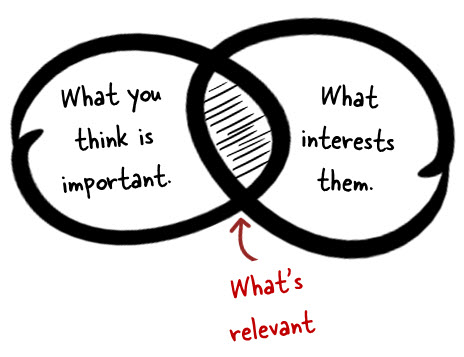
    As I thought back on the call later in going over my notes, I noticed something in the transcripts. These leading members of this group had used the word “relevant” in their discussion of their wants and needs regarding the association no less than 20 times in a 90 minute call! Clearly, they were calling for the association to pay attention to them and to offer something they found valuable, that they could use to improve their work, status or professionalism. In reviewing our earlier work with other organizations, it became clear that many of them have a sector of their constituency that gets short shrift in the overall scheme of things. In our experience, the cry for relevancy becomes louder the more homogeneous your group becomes, and the minority becomes smaller as a part of the whole.

    For organizations serving a diverse population, the need to take into account multiple points of view, diverse needs, forces them to think more broadly, to offer benefits that fit a wide range of sub-sector’s needs. When the group becomes more homogeneous and a small group stands off to the side, it becomes less and less cost-efficient to serve them with their own set of benefits and offers, to serve them in a way they are used to being served. This type of behavior is often a precursor to an association splitting into smaller, splinter groups, each with diverging needs and desires and expectations.

    In short, the benefits offered the majority have failed to continue to be relevant to the minority group. Chances are, the main group’s marketing efforts reflect this, and if not corrected they will start to see participation, purchase response, renewal rates, and all the other touchpoints they measure decline for this one small group. This lack of relevance can drive the entire organization into a negative spiral if not caught early and rectified.

    So how do you fix the lack of relevance? In a word, research. Most organizations will tell you that “they know their members very well”. It has been our experience that the more they say they know their members, the more they live by that assumption, and the less they really know the membership’s needs, wants and preferences. This particular blindness seems to afflict trade groups more so than membership societies, but it applies to both.

    If you want to know what your members really think of you, and your products and services, ASK THEM! You’d be surprised how readily they will offer their opinions, how honest they will be under the right circumstances, and often how simple their needs are to meet. Once their inputs are incorporated into the organizations behavior, the association will start to experience much higher total lifetime values across the overall membership, much better renewal rates, much less cost to keep members, much less spent on recruitment marketing, and that effect trickles down through almost all aspects of your organization, creating much better fiscal health and well-being throughout.

    Organizations that regularly and routinely poll their memberships, that ask intelligent, probing questions, in order to spot shifts in perceptions, identify under-served areas, failing programs, and budding successes, will predictably do much better then those who feel that surveys and other research are “invasive” or “irritating” to the members, and only survey them once every couple of years with the same routine and detached questions. Get to know your membership segments for real, reliably and recently, and use the knowledge to shape your education programs, to craft your conference offerings, to guide your tradeshow approaches and themes, to guide your publications’ editorial calendars, to adjust your website, to shift your media selection for outreach, and you’ll be amazed how much more “relevant” you are to the membership – even the smallest segment you have!

    If you found this post insightful or helpful, and you’d like to read more, subscribe to this blog above – and don’t forget to pick up your copy of “The Marketing Doctor’s Survival Notes”


  • Brand Effectiveness Key to Membership Growth, Part II

    Brand Effectiveness Key to Membership Growth, Part II

    Here’s part II of yesterday’s post . . .

    Brand Effectiveness Key to Membership Growth – Part 2

    In Part One, we discussed using in-depth member survey work to boost the visibility, awareness and effectiveness of your organization’s brand, and how it can directly impact your ability to recruit and retain members. If your organization isn’t the first thing member prospects think of when they turn to industry issues, there’s work to be done.

    Your survey may provide mixed results that don’t show a clear direction. Often this is an indication that there is a disconnect between the brand you put out to the external world, and the one you use to craft the questions! That alone tells you something, and a series of follow-up interviews with the same basic set of queries to the external and internal groups should help clear up the discrepancy.

    Other sources of data can help you check your brand effectiveness as well. Interviews with those alternate stake holders should be couched slightly differently, and can use more “insider jargon” in the questions, as their awareness starts off at a higher level. They can give you a median read, between the internal and the external, and this can often help you reconcile the disparate results mentioned above.

    Take Stock

    An inventory can be helpful in analyzing your brand’s effectiveness. Simply create a list of all the places where your brand appears, in what context, what medium, attached to what product, message or outreach vehicle, and see if they seem to have an obvious pattern, if they are aligned. Often pulling samples from the archives and lining them all up together can be very enlightening. You may be unaware of a brand shift that may have occurred over time, small miscues that send a less the consolidated message to the recipient. One example of this is when an outsource vendor or contractor uses your brand in their program, and it doesn’t match your normal set of brand characteristics. If you are seen as a very sophisticated, august and professionally ethical branded organization, and an outsider puts your logo as a sponsor on a ticket giveaway coupon for a concert, that would be a brand slip or miscue. If several of these items have crept into your inventory, it may be time to put some tighter controls on the use of your brand, and provide some increased education within the organization about the importance of protecting the brand and how to use it properly.

    Top of Mind

    Keeping memorability high is another positive effect of a well –aligned and effective brand. If your brand is consistent with individual experience, that experience will be more memorable. L.L. Bean shows a great example of this. Their “Return any time, no questions asked” return policy has been with them since virtually the beginning of the company. They were so confident in the quality of their products, they couldn’t dream of anyone sending them back, and thus the perceived risk of such a policy was low. That policy became part of their brand, and is now a deeply embedded positive characteristic, so much so that there was near revolt when a senior staffer proposed eliminating it to help save money. As it turns out, their return rate is notably lower than their competitors, and the savings realized would have been more than offset by the damage to their brand as a trusted, honorable retailer of fine outdoor merchandise. As a result, when you get an L. L. Bean catalog in the mail, you instantly put in the back of your mind that the purchase from there is of lower risk, and therefore a greater possibility, as a result of that policy. That gives them a competitive advantage, and keeps their customer retention high and their loyalty even higher, due to the memorability of that policy.

    Brands Aren’t Built In A Day

    If you’ve launched a new product, are a new organization or subgroup within a larger organization, you know the difficulty of setting the stage for a lasting brand. It takes many, many customer touches to build a brand effectively, and with non-profit, member driven organizations, the rate of touch is often affected by budgetary constraints. That puts the building process on the slow track, as the mailings, e-mails, directories, guides, meetings and other activities slowly mount up in the member’s mind. Each piece of the building process must be consistent, and have relevance and meaning for the recipient, or you undo much of the positive work up until then. Be patient. It can take years for an organization to reach a highly memorable, effective state with its brand, and many a good program has been discontinued by impatient senior staffers with a more cautious eye on the bottom line than knowledge of the branding process and its benefits.

    If your brand message aligns with expectations, your touch rate is predictable and rising, and your organization has shown relevance for the audience it wishes to serve, you’re on your way to a highly effective brand.

    If you’re concerned about your brand’s health, effectiveness or strength, and would like to take advantage of our expertise on these topics, be sure and subscribe to this blog, and pick up a copy of “The Marketing Doctor’s Survival Notes” 


  • Is A Graduate Degree Keeping You From Getting Hired At A Start-up?

    Is A Graduate Degree Keeping You From Getting Hired At A Start-up?

    I came across this article, Why Start-ups Shouldn’t Hire People With Graduate Degrees by Penelope Trunk on bNet, and thought it was particularly appropriate for our Entrepreneurship Practice – having lectured at both undergraduate and graduate level and worked with a variety of students, I feel this rings true. Having worked with start-ups and started seven businesses in the last 30 years, I can relate to the pool of talent that comes out of b-schools over the last three decades – they need more resources, more management time and more seasoning than undergrads with 2 years of work experience ever did. They whined more and produced less than their less educated counterparts, too.

    See if you agree after reading Ms. Trunk’s words of wisdom . . .

    It’s likely that if a person attended graduate school, he will have a hard time translating his strengths into strong workplace performance — especially at start-ups.

    Most people who went to grad school did it to prolong adolescent needs for grade-based approval. (Note: This analysis comes from writers at the Chronicle for Higher Education.) This is because the grad school model is generally outdated for today’s workforce, and high performers see this before they enroll. But people who are scared of trying to hold their own in the workforce see grad school as a way around the inevitable difficulties of finding a job one enjoys.

    Here are three reasons why it’s a decent bet to stay away from candidates with graduate degrees when you need to hire at your start-up:


    1. Humanities are for people who are afraid of adult life.

    My experience with graduate school was for English. I tried it when I couldn’t figure out what job I was qualified to do.

    The answer, in fact, was that I was not qualified to do any job before grad school — but I was not qualified to do any job after grad school either. So I left early, without the degree, when I realized graduate school is stupid.

    It’s not just the field of English that is a dead end. One would have had a better chance surviving the Titanic than getting a job as any type of humanities professor. Humanities PhD programs suck up time and energy with little return.

    Most people who go to grad school for humanities defend their decision by saying they love their topic. But look, if you love your topic, you can do it after work. Just open a book and read it on your own.


    2. Business school is for people who lack ideas and initiative.

    The big question you should ask when business school graduates tell you they want to work for your start-up is: Why did these people just dump $100,000 into a business degree instead of dumping it into their own company?

    If they really wanted to work at a start-up, why didn’t they launch one? Clearly, money was not the barrier, because they had $100,000 to burn. So it’s something else.

    I think they don’t start companies because they do not have any ideas. Or, in the case where a person actually does have ideas, he doesn’t believe in himself enough to give his own ideas a shot.

    So why should you believe in this person?

    Take a look at how many smart people write about how business school is not a good path to entrepreneurship. The only reason we are even talking about business school in relation to entrepreneurship is that so many people want to be entrepreneurs that business schools had to launch entrepreneurship programs to attract those people.

    During my days as a journalist, I interviewed Saras Sarasvathy, from Dartmouth’s business school. She explained to me the research about the traits of a successful entrepreneur. And believe me, none of those traits requires a degree from business school.


    3. Law school is for people who lack creativity and will likely fail in the workplace.

    Yes, this is a generalization. But there is pretty good evidence to back up this generalization.

    For starters, most lawyers hate being lawyers. There are five, big myths about being a lawyer, but the main problem boils down to this: To get in to law school, you have to be great at school (reading and regurgitating back to the professors what they want to hear) and you have to be great at test-taking (the LSAT still rules admissions).

    So law school selects for people who are rule followers and like to be told what to do.

    But to be a successful lawyer, you have to be great at marketing and client relations. Otherwise you won’t make any money because you won’t bring in any business.

    People applying to law school ignore this problem. (And so do law schools, but that’s another story.) The reason law students ignore it is because they are so desperate to have a clear path to money based on the skills they have exhibited in school. The desperate need for a safe route makes people ignore the fact that law school is very, very high risk for an unhappy life.


    4. People with multiple degrees will be a pain in the ass.

    Why would anyone get two degrees? It’s like being a triple major. Anyone who is a triple major as an undergrad is likely to be awful to work with. A triple major is myopic in her knowledge, insecure with her own identity, and desperate to impress. There is no good reason to have a triple major in a world where it’s clear that an undergraduate education does not really teach you anything about your major anyway.

    The same can be said about people with multiple graduate degrees. It’s just that as an undergrad, the triple major is trying to find an excuse not to have to socialize. A graduate student is trying to find an excuse not to have to embark on adult life. And that’s not the kind of person who’s going to add a lot of value to your company.

    Which leads me to the best hire you can make: Someone who faces the difficulties of adult life head on and takes personal responsibility for building his own skills. Someone who makes time to develop social skills, test his own ideas, and take risks that are scary but necessary for growth.

    Those people often look messy. Adult life is messy. But it’s better to hire someone who has waded through the mess of growing up than someone who has avoided it at all cost.

    If you find this strikes a nerve, or if you think it’s spot on, and would like more, subscribe to this blog above – and don’t forget to pick up your copy of “The Marketing Doctor’s Survival Notes” 


  • Ten Tips & Truths For Marketers

    Ten Tips & Truths For Marketers

    For those of you who are marketers, or if you’re a business owner or solo practitioner who acts in a marketing capacity (and who doesn’t), here’s a few things I’ve picked up over the years – they don’t have anything to do with social media, channel support, SEO or anything to do with a particular media.

    10) If you’ve worked hard to evoke an emotional response to your product in an ad or direct mail piece, for goodness sake give people a way to actually buy it! Make the response mechanism obvious, it avoids delay in responding.

    9) Put your address and phone number on your website, in an obvious place – not everybody trusts everything they see on the internet, and sometimes you just want to send somebody something or talk to an actual person. Why make me work at it?

    8) ASK for the order. Don’t assume that the audience will understand what you want them to do, no matter how obvious you think it is.

    7) Take the offer seriously in your ads and direct marketing communications – the audience will, and they will hold your feet to the fire for every possible interpretation you can imagine. The more transparent and clear you make the offer, the less confusion you’ll receive from the audience, and confused audiences tend not to buy things.

    6) Treat your house list like the gold that it is – you’ll never find a more receptive set of eyes and ears for your message than someone who is already predisposed to hear it. Respect the power it represents, and the people behind it.

    5) You can never know too much about the people you’re trying to reach – but you can interpret data incorrectly. Trust but verify, to paraphrase Ronald Reagan, and vet your data with real people and anecdotes – you’ll be glad you did.

    4) Make your copy simple enough that your 80-year-old grandmother can understand it. People’s attention spans are increasingly short, and they don’t have time to analyze your obtuse copy to extract your message.

    3) Sales letters should be long enough to compellingly tell the story, and not a word longer.

    2) Lists, design, artifice and devices don’t sell products and services, feelings do. Evoke an emotional response in your audience and you’ll move the needle.

    1) A target audience never bought anything – PEOPLE buy goods and services – whether it’s online, through the mail, over the phone or from a billboard. Reach out in an accessible, human way, meet a need or solve a problem, and the sales will follow.

    Seems like basic common sense, but ignore such simplicity at your own peril. You’d be amazed how many top flight professionals can’t apply these basic tenets to their everyday work and score a good number.

    If you found this helpful and would like to read more like this, subscribe to this blog above, and be sure to pick up a copy of “The Marketing Doctor’s Survival Notes”


  • Fundamentals Can Save Your Advertising Program

    Fundamentals Can Save Your Advertising Program

    As a consultant, I read – a lot – every day, about different marketing approaches, different angles and aspects of marketing, from social media trends to mobile, to automated e-mail, to article marketing, and a huge variety of other things that bombard my in-box every day, both electronically and in the snail mail and online. With all that reading and absorbing comes some inherent sense of how current corporate professionals in the marketing field are going about their work, what they focus on, what they feel is important, what’s hot and what’s out of fashion.

    In all that absorption, I get to analyze how those marketers work, and how effective their efforts are. I also get called upon to critique their work from time to time, and let them know how a “knowledgeable” audience might view their performances. I was judging a series of ads the other day for a survey of magazine ads and their effectiveness, and I was amazed at how many of the B2B ads didn’t incorporate even the most fundamental, basic elements that should be in all advertising. Top professionals at high-priced agencies were creating ads read by, and hopefully responded to, by other professionals – and there were lousy headlines that were far from compelling if there was one at all, lists of product features with no associated benefits, copy that was difficult to decipher, let alone read and be persuaded by, and a host of other ills that most college-trained marketers have a good handle on by year two. I was amazed and astounded that large, profitable companies with marketing departments staffed with educated, qualified professionals were paying for this level of performance from their agencies, or worse, producing this kind of product themselves!

    Sure, it’s easy to rely on others to cover the basics, and you hope that the high-paid pros know better and they shouldn’t need much supervision. And it’s easier still to simply look at last year’s or last week’s effort and say, “yeah, good enough, run that one again” and perpetuate the poor construction, bad design, lousy and ineffective headlines, poorly-written copy that is neither persuasive or compelling. If it wasn’t, we’d be out of business. But the truth is, if these pros had simply focused on the fundamentals, their work would improve in both effectiveness and creativity.

    1) Get me involved. Write a real headline, one that compels me to read further, that poses a problem a challenge, asks a question, declares a position or benefit.

    2) Write and design it so even I can read it. Real type fonts, in a decent size, in a contrasting color, either in columns, wrapped around an image, bannered at the top or bottom, somewhere that my eye can track it and make sense of it. Make it compelling, readable, persuasive, tell me how it will make my life easier, faster, better, lighten my workload, solve a problem, keep me sane, let me sleep at night, beef up my paycheck, cut my expenses. Tell me the benefits of the product or service, not just what it includes or is comprised of. Tell me something to make me feel I “need” what you’re selling, hopefully leading me to . . .

    3) Include a call to action I can respond to. I get through the headline, it drives me to read the copy to learn more, it ends, and . . . nothing! Give me a phone number, a specific web address, an e-mail or physical address, an offer of some kind, a place to go to learn more, see the product, make a purchase, someone to call to order one, something!

    4) Lay it all out so it naturally drives me to that offer. Americans read left to right, to to bottom, its deeply ingrained in our psyche to do so, so that we may all absorb information in uniform fashion. Don’t fix it if it isn’t broken, start at the top, (it’s called a headline for a reason) and work your way down. Leave the collages for grade school, keep the fancy special effects for the YouTube video – just design it in a way that is pleasing to the eye and supports the other elements.

    5) Make the images and the text support each other and work TOGETHER to get your point across. I can’t tell you how many ads I reviewed that contained an image that had virtually no bearing on what was being sold or discussed. It was either a product shot with no identification or name, no branding, or known function or relevance to the headline or offer, or a shot of some landscape or character that had no real bearing on what was being discussed. You’ve spent a lot of time and money finding, modifying or creating that image, make it work to your advantage to help sell the concept or idea you’re conveying.

    Just following these five guidelines will improve your publication and print advertising immeasurably, and put you ahead of 70% of the highly paid agency professionals that crank out B2B ads on their lunch hour . . . you might even make a sale!

    If you found these helpful, or disagreed with these insights and would like to let me know . . . subscribe to this weekly blog above. And, don’t forget to pick up a copy of “The Marketing Doctor’s Survival Notes”


  • Tradeshow Promotion Requires Strong Planning

    Tradeshow Promotion Requires Strong Planning

    Recently we’ve been approached by several tradeshow organizers to review, upgrade, or revamp their marketing efforts, for a variety of reasons. With all the visibility and power perceived by marketers who use social media, often tradeshows get put on a back burner. Often there are misconceptions about the cost, value and ROI of exhibiting in a tradeshow, and those impressions are what the organizer is fighting when they try to attract new exhibitors, or build attendance. There are other aspects of working tradeshows into your marketing plan that are misunderstood or poorly perceived that present challenges to the organizers.

    We’ve been working with exhibitors, and organizers, to eradicate some of these misconceptions, and to maximize the value of the tradeshow marketing channel as a viable means of penetrating a new market, launching a new product, or raising awareness of a new application to a new vertical.

    When we work with organizers, its often to open up the shows to include new markets, to add new exhibitors and expand the show, or shift it’s focus. This involves building a strong marketing platform, and a focused sales effort, working in tandem, to approach new exhibitors with a fresh angle or a new spin to show them the value of the show to their sales efforts. Creating a solid prospectus that tells the story accurately and gives the exhibitor a feeling of confidence that the organizer speaks their language, that he understands their market, and that they are competent to make their experience a good, profitable one, is one of the first steps. As always, there’s a lot of research involved in creating that element, to gather data on the buying audience, demographics of the attendees, the market as a whole. Once that trust is established, then it’s a matter of making contact with the correct individual to work through their issues, concerns and needs to prove to them that the organizer will be with them every step of the way.

    When we work with exhibitors, it’s usually to help the exhibiting company break into a new vertical market and to make an impact, to raise awareness of their firm within the industry at large. In those cases, its a matter of getting the attention of the audience, and even of the other exhibitors, be they partners or competitors. Sometimes it’s not just a matter of buying a sizable piece of real estate and designing a flashy display. We’ve worked with some companies where it was appropriate to do exactly the opposite – purchase the minimum size space, install a low-key display, but participate heavily in other parts of the overall marketing opportunity, like sponsorships of events, banners in the halls, kiosks, hospitality suites, press conferences and publication ads in directories, maps and schedules. These kinds of activities require lower levels of human resources, help present a unified and ubiquitous-appearing presence, while not spending on expensive floor space and having to furnish it with a large staff and display.

    No matter who we’re working with, it all starts with research and planning to maximize the opportunity presented by the show. Solid planning and a knowledge of the audience can make even a marginal show a resounding success, generating revenue, growth and partnership opportunities, and helping markets expand and driving commerce. If you work in the tradeshow space, let me know what challenges you’re facing – we’d love to hear from you.