Category: Uncategorized

  • Time . . . The Scarcest Commodity Executives Have

    Time . . . The Scarcest Commodity Executives Have

    When we asked 150 senior executives from Marketing, Sales, Operations, Administration, and Human Resources, what one thing they wanted to make their day more manageable, the vast majority answered with the same response. It wasn’t great software or IT support, it wasn’t higher salary, it wasn’t free sodas or a ping pong table in the break room, or T-shirt day, or birthday cake for all . . . the most popular answer was just one word – Time.

    Executives are starved for time – time to think, to contemplate, time to digest and cogitate, time to reflect, time to delegate, to mentor, to research, to connect on more than a cursory level with their colleagues. Prioritizing of their schedules, maximizing time efficiency, finding ways to do more than one thing at a time or to parallel schedule so that multiple tasks coincide, are the number one mental activity on a daily basis for senior leaders.

    Their plates are more than full.

    Between their own business responsibilities, outside Board affiliations, community and charitable organizations, sponsorship obligations, professional association activities, speaking engagements, family commitments and personal networking, the 18-hour day is becoming standard for senior leaders of national and global firms. While many would intone “That’s why they get the big bucks,” and “should have known before they took the job,” no amount of money or foreknowledge would have compensated or prepared the normal individual for that level of constant activity and commitment. It’s a grinding pace, and it can only be sustained for so long before their personal health and often the health of the firm suffer as a result. The average tenure of a global level, publicly held firm CEO is less than three years, and it stands to reason that the schedule, and the hunt for unscheduled time, might have a great deal to do with that. While capricious boards, fickle investors, vague and punishing financial markets add their own land mines to an already dangerous traverse, the level of personal energy required is virtually unsustainable by the average human.

    Ari

    For those who need access to, and engagement from, these top C-Suite officers, this insight could mean the difference between productive contact and being put in the “pay no mind” column. Long, rambling voice mails, five-page e-mails, 9-lb promotional brochure bombs, 40-page white papers, are just not in these guys’ future, and will not only deny you the attention you need, but irritate the recipient for not respecting the limited time they have available for such activities. It’s not that they don’t want to engage with you, or that they’re ignoring you, it’s just that you’ve come in at the end of a very long priority string, and have to wait your turn. The more hurdles you place in the way of that turn being productive, the lower your odds of connecting in a meaningful way.

    Short, sweet, decisive, get-to-the-point type communications win the day for these guys – strong, direct images, simple, direct language, compelling offers, real business cases that apply directly, and have relevance to them, are the key to success. Think about it: if you have a line of people waiting outside your office, a full calendar, a charity dinner and speech to prepare, and are flying to a board meeting later in the week, the last thing you want to do is wade through a long, rambling memo, a multi-page brochure with a barely comprehensible letter, with a tentative, limp offer that barely fits within the company’s “needs” basket. Poor choice of activities at best, when there are that many other, potentially more lucrative things waiting in the wings. A short e-mail promising a viable alternative and offering lunch next week, a few sentences at best, is more likely to get some attention.

    Time is one of the few elements of a person’s job that they have limited control over. Time can’t be manufactured, can’t be augmented, can’t be stopped or delayed, bought, coerced, finagled, negotiated or bullied. It marches onward, unbidden and unaffected by your need for more, or to speed up or slow down to make room for more tasks. So, the main goal is usually just to prioritize the time you do have, to maximize the return on effort expended, and meet as many obligations as possible. Where those priorities are allocated, how they are parsed and balanced, is often the difference between success and not, over the long haul. A famous executive has been quoted as saying “I have time for the important things. The questions is, what is important at the time?” Pick the things that are important to you long term, and prioritize them above the rest – success can’t be far behind, however you define it.

  • How To Think Like Designers

    How To Think Like Designers

    This is What We Do – Thought this was interesting . . .

     IBM hires hundreds of these workers to shake up clients — including Vodafone — and figure out what customers want

    JUSTIN TALLIS/GETTY-AFP

    What do your customers want? That’s not a skill that comes naturally to the engineers who build software for big corporations. But in a world filled with user-friendly smartphone apps, clunky enterprise software is no longer tenable.

    So to shake up the status quo, IBM, Cognizant, Infosys and others have been racing to hire thousands of designers who once would have taken more specialized jobs-at an ad agency, say, or an industrial-design shop.

    At IBM, they team up with engineers and consultants and embed with a multiplicity of clients. Besides providing customer i nsights, t he t eams encourage constant feedback and tweak products as they’re built — a process aimed at getting them out faster. It’s how successful Silicon Valley startups operate but radical for the IT services industry.

    IBM Chief Executive Officer Ginni Rometty has bet the future of the services division on design thinking. She badly needs the strategy to work if her company is to reverse 17 consecutive quarters of falling revenue and adapt to a cloud-based world. In the past few years, the company has recruited about 1,250 designers, built a global network of design studios and is training employees to incorporate design thinking into almost everything they do.

    By the end of this year, the company says, about a third of the 377,000-strong workforce will have been retrained. The goal is to build a customer-centric, startup-esque culture — and then persuade clients to do the same.

    Brian Corish never planned on joining a big corporation like Vodafone; the serial entrepreneur was used to working at startups where knowing what the customer wanted was baked into the DNA. But when the head of Vodafone’s Irish operations came calling for help enhancing the company’s online pres- ence, Corish saw an opportunity to teach the startup ethos to a company with lots of unused information about its customers.

    His new bosses didn’t say precisely what they meant by the digital transformation, but Corish soon concluded he needed to reorganize the entire culture around its customers.

    As a big, established company, he says, Vodafone hadn’t bothered providing the best consumer experience because it already had a massive customer base and was making money building and selling products the way it always had.

    Corish decided to bring in outside help but was underwhelmed when all the consulting firms talked up previous projects rather than focusing on the challenge at hand. IBM sent its team back for a second try. This time they ran design thinking exercises with 30 or so attendees.

    A lot of the discussions centered on actual customers, what they didn’t want and what they wanted more of. Darren Gerry, an IBM designer, says Vodafone attendees were shocked at the revelations, having never thought about customer needs and desires in those ways.

    To start, IBM was asked to build a self-service portal that would let employees working for Vodafone’s enterprise clients order phones and other workrelated gadgets themselves.

    Gerry says his team developed a close relationship with the client, keeping the project transparent and demonstrating to Vodafone how design thinking works. Corish, keen to teach as many people as possible about design thinking, helped facilitate the indoctrination, starting at the top; that’s when senior management met the Snapchatobsessed teenager.

    Traditional enterprise software projects can drag on for years before bearing fruit. IBM delivered the first version of Vodafone’s self-service portal in six weeks. Corish says his colleagues were astounded how quickly the job got done. “The rest of the organization went, ‘ Oh, you really can do this,’ ” he says. “It doesn’t have to take five years.”

    Before the self-service portal was built, enterprise clients had to call Vodafone to order a new device, often spending days getting it configured. Now they can use their own logins to order a phone or tablet, which arrives in a couple of days and works right out of the box. “If we don’t focus on the customer,” Corish says, “we’ll be irrelevant.” Much the same could be said about IBM.

  • How To Become Customer-Centric . . .

    How To Become Customer-Centric . . .

    Whether its B2B, B2C, global enterprise or local start-up, commercial or non-for-profit, all types of business can benefit from becoming more customer-centric. But what does that mean, what does that look like, and how can you achieve it without recreating your business from the ground up?

    True customer centrism is as much an attitude, an approach, as it is a model or structure, which means if companies want to take advantage of all the positives derived from knowing and treating your customers better, it all starts at the top, it’s built into your corporate or organizational culture, deeply interwoven into your corporate DNA. It’s one of several facets of business where you can’t just “talk the talk,” you HAVE to “walk the walk” every day, day after day, from all employees, customer-facing or not.

    OK, so now that you have the attitude adjusted, it’s time to check the altitude. That requires some real, trusted, correctly executed research data. But where do you start? One aspect of research data is that it’s like lettuce, it needs to be fresh to be at it’s best. Which means you need to develop a way of gathering data from your customers that you can rely on to be accurate, to pull from a high-confidence sample size, and can be put in place relatively quickly and can be relaunched on a regular basis, once a baseline is established. Surveys can be used in some instances, depending upon what you’re trying to accomplish. Our preferred methodology is the IDI, or In-Depth Interview. It’s a semi-scripted conversation, 30-60 minutes in length, guided by a pre-written discussion guide, executed by trained researchers, NOT telemarketers, who can hold an intelligent conversation with a wide range of professionals and consumers. That conversation is geared toward gathering not only facts about your customers buying habits and purchase patterns, but about their attitudes, feelings, preferences, and moods regarding your products, services or brand. Many of those will be driven by their most recent experience with your company, usually an interaction with either billing or customer service representatives. Keep this in mind when doing the data analysis later, its one of the reasons why research data needs to be fresh.

    Each IDI is recorded, transcripts made, each question response is then tabulated, and the responses segmented into positive and negative piles, or into a range of “buckets” based on type of response, severity of feeling, and prevalence among respondents. Those data points are given to three analysists (in our practice, anyway), and three independent analyses are written up based on the same data, to mitigate bias and skew. That’s the basic methodology, but the key to using these successfully comes in the performance of the questions themselves – if you don’t ask the “right” questions, you can’t act appropriately on the answers and achieve the desired result. That’s where the magic happens.

    Now that you have your data, and have done the analysis, now what? Data is just dumb numbers and words unless it leads to, or can be converted into, some positive action with respect to your customers. Some of the data will be most useful in making adjustments operationally to customer-facing processes. Is your fulfillment process causing problems, is the return policy too restrictive or difficult, is your phone tree routing system too complex or directing people insufficiently or are the menu options wrong – those are things that can be adjusted and shifted based on the data in a very direct way. They make a big difference in the customer experience, and can certainly affect their attitudes and emotions toward the company in the short term. It gets a bit more complex when you start examining some of the deeper attitudes and preferences about the company and its brand, what the company and it’s products mean to them emotionally, what feelings does the brand bring out in them, and why. Those are brand-linked attitudes and emotions, formed after repeated interactions and touch points with the company, its outreach materials and products. It’s much tougher to pin down the cause of these aggregate attitudes, but worth the time if you can make a correction that rights the brand’s direction going forward.

    At this point, many of the smaller B2B companies and service firms are thinking, ”isn’t that up to our sales people to assess those things and listen to their customers and shape their offer and interaction accordingly?” Even if your transaction volume is very low and your client number correspondingly low, there is still much to learn about your customers by doing research, and to be able to adjust your marketing to find more of them as a result. In fact, smaller, lower volume firms can make a bigger impact by paying attention to brand influence and making customer-centric adjustments than a larger firm can – small changes make a bigger difference in their bottom line, and a small increase in customer volume makes a bigger difference financially as a percentage of overall revenue.

    It’s said in the psychiatric profession that admitting you need help puts you half way to a cure. Becoming customer centric as a business is a similar situation – by discovering that you can improve your growth, meet objectives, increase revenue and profit by knowing your customer better and serving their needs more directly, you’ve already planted the seeds of that first attitude adjustment step, a big move forward in the process. Communicating that attitude down through the rank and file so that it becomes pervasive throughout the firm is the next step. Strong belief, direct simple communication, and a solid, positive example shown in every corporate action is the key to building a more customer-centric organization. No time like the present to get started. If you don’t know where to start, we’d be happy to help.

  • The Power Of Words . . .

    The Power Of Words . . .

    Marketers use words for many different purposes, to persuade, to cajole, to express urgency, to instill fear, to provide an identity, to convey calm or safety or trustworthiness. We’re like superheroes, in that we can use those powers connected to words for good or for evil, to help customers find the perfect item or service, or to drive them to register for a worthless but exciting-sounding product that they may regret later if indeed they ever receive it. Despite a documented decrease in the average person’s vocabulary inventory, the power of words has never been stronger. How far can that trend be extended?

    Our fervent hope is that it be reversed, that the general populace realize the power of words, the need for a full-scale, broad-spectrum education, which can open doors far beyond computers and technology. As little as 50 years ago, the average American high school graduate had a strong grasp of their own language, could read and write at a reasonably consistent level, and was equipped with the tools to take them as far in life as they could achieve using public, published information sources. The library was a place of knowledge, of reverence, and for those equipped to use it to its fullest potential, a place of wonder and excitement.

    Today, that same American graduate has a smaller functional vocabulary, lower level spelling skills, is slower to comprehend what they read, and can often not fully absorb the daily newspaper, which is typically written on an 8th grade reading level. They can also carry a small library in their hand, on a digital reader with a collection of public domain books, and with an internet-connected tablet, can learn things about the world around them every minute of every day. However, the words may be there and be readable by nearly all, but the wisdom and the editorial judgement and curation that vets those words are no longer present, so the onus is on the reader to choose their sources wisely, to choose who to believe very carefully. Inaccurate words have the same power as the accurate ones, and travel just as quickly.

    Marketers of questionable ethics and flexible morals have been known to take advantage of the power that words possess, to portray a situation or product in a certain light that might take advantage of those whose comprehension of words and their discernment of nuance of phrases might be diminished. Good marketers know they needn’t stoop to that level to be fantastically successful at what they do, to engage and persuade and enlighten audiences and provide a gentle nudge toward purchase. But the internet has become a playground for the more nefarious among us, causing the average person to act with additional caution when reading anything online, regardless of its source.

    Marketers need to remind themselves that this tactic of deceit and misdirection is a game of diminishing returns, that the more tricks, click bait, misleading tags and headlines that appear, the fewer people who will investigate anything in that channel overall, reducing response rates and cutting profits to the point where the credibility of digital outreach will reach a low ebb, and a new approach will have to be put in place. Those who are agile and can adapt to the new paradigm with flourish, those who are more Tyrannosaur-like will perish in the aftermath of the volcano. Be mindful of the power of words that you hold in your hands – misuse of that power affects us all . . .

  • Are You Selling To The Right People?

    Are You Selling To The Right People?

    We’re big advocates of using research, especially primary customer research, to drive marketing and sales efforts. It’s much more difficult to miss the target when the target is telling you how to hit it, how far away it is, and where your arrow is in relation to itself.

    Sales benefits as much from research as Marketing does, but in different ways, and by using different pieces of data. Primarily, Sales will be ale to use data to determine who is, and how well-qualified is, the audience of one (company) in front of them. With a list of several hundred prospects in their satchel, Sales people have to determine if this company is even realistically a prospect at this time, who inside that company they should approach, who the actual decision-maker is, and how best to reach out to them to get the warmest reception.

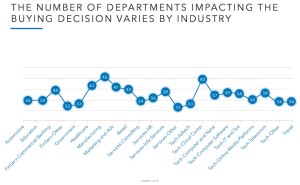
    New research has shown that trying to pinpoint a single individual decision-maker may be a futile and even damaging effort. Corporations are so integrated, so closely cooperative, in an effort to move forward more effectively, to make purchasing of goods and services more streamlined, and maximize cost-effective use of resources, that an average of 3.4 departments get “in on the purchasing decision”.


    departments-LG-linkedin-100516


    That number differs depending on the industry, with manufacturing scoring a surprising 4.6 departments needed to make a purchasing decision, and some smaller non-profits scoring a 2.1 or less. Reasons for this are less clear, but the prevailing theory is that the classic manufacturing firm has fewer distributed costs, centralized purchasing for raw materials, and the purchase affects more departments’ budgets and ability to function as a result. Fewer “silos” leads to more people involved in making decisions.

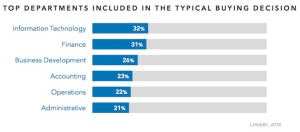
    Which departments are involved makes the picture for Sales even murkier, with variables including cost of the purchase made, length of the sales process, number of touchpoints that selling company has with the target firm, and the nature or structure of the product or service being bought. Things like consulting services, legal assistance, accounting services, tend to have more folks weigh in on the decision, based on the number of departments such an engagement will touch within the company. Things like maintenance and physical plant services typically fall so squarely within Operations, with a touch on accounting and finance, that usually there is only one true decision-maker. The decision to spend the money has more involvement, but the actual vendor is pretty straightforward and stays “local” most of the time.


    influence-linkedin-100516


    The bottom line is that sales people need to do a certain amount of probing and due diligence when qualifying prospects to make sure they are not only aware of all the various inputs in the buying decision, but that key stakeholder are not “left out” of the communication chain, to avoid making them feel ignored or worse, disenfranchised. That kind of innocent mistake can torpedo even the most potent sales effort, and it may be happening and you don’t even know it.

    The time spent doing this type of research is almost always time well invested, if for no other reason than to allow the sales person to speak with confidence about the target company. Additionally, it avoids the type of error described above, and allows you to streamline the process and avoid real time-wasters, like selling for months to the wrong person(s).

    This type of information should be prominently noted in your CRM entries as well for each prospect, not only as a reminder to you, but as a signal to others viewing the reports, who may be able to suggest a new approach, or use a contact in a department you have yet to approach. Share the wealth.

    Do your homework, include and approach the “right” people, and be aware that it will likely take a unanimous decision among up to four full departments to close the sale. Knowledge is power in this instance – go forth and be powerful!

  • Is Your Business Card Your Most Powerful Marketing Tool?

    Is Your Business Card Your Most Powerful Marketing Tool?

    Think about it: Every meeting you attend outside your company, every business function you attend, every group you join, even casual encounters at sporting events, concerts, classes and athletic competitions like races and charity bike-a-thons, the one thing you can use to conveniently provide your contact info and your business “story”  to a new acquaintance is your business card. It carries your company brand, it carries your professional reputation, your phone number, e-mail address, website URL, physical address, even a level of achievement and professional status – that’s a lot of heavy lifting for a piece of card stock 2″ x 3.5″!

    For small businesses, the many choices made in creating a business card are each vitally important to be sure it can carry all that weight effectively. Nice layout but thin, flimsy stock says I’m just starting but don’t have the resources to spring for the good stuff (sending a subliminal message that maybe I’m not concerned with other details of my company’s image, either). Standard white with black type might send the message that basic is good enough, I don’t care enough about appearances to even pay attention to subtle design cues and engagement that some color can create. Way colorful and “cartoony” might make it difficult for the recipient to grant your firm the importance and weight of consideration it deserves. Lots of type and images of you might come off as narcissistic if over done. Too “designy” might reduce the impression of seriousness and business acumen that goes behind your creative decisions. Type too small to read, too much information packed in illogical order, funny, multiple or odd type faces that make it difficult to read or absorb quickly, are all poor choices, and we’ve seen them all at one time or another. All these choices are critical to convey the message in just the right way that really makes you memorable, carries your brand effectively, and connects that person who receives it with the way you can somehow help them achieve their goals, no matter what they are. Like I said, a lot of pressure for a small scrap of paper . . .

    With all that going on, it’s usually best to leave the design, layout, and production choices to a design professional who has a reasonable portfolio of business identity work. That doesn’t mean your new sister-in-law who just graduated from art school can’t take a crack at it, depending on what type of business you’re starting or promoting, but her input should be able to stand on it’s merits, not on her attendance at Thanksgiving dinner. There are basic design tenets that should be adhered to when crafting an effective business card (and other identity materials), but those tenets leave a huge margin open for creativity and ingenuity! Don’t feel boxed in by convention, just give due weight to the experience of those who are successful at creating these little buggers.

    For the money, business cards can be your most effective weapon in the battle for recognition, growth, brand awareness, new customer acquisition, and professional networking success. Its certainly the oldest, and most valuable dollar for dollar. Sure, digital elements are global, changeable, adaptable, mobile and modern, but the lowly business card travels further, gets kept longer, is more portable and shareable, carries more information and meta-information, more memorable tactility, and more engagement than a web banner ad URL could hope for on its best day!

    Next time someone hands you their business card (hopefully you asked for it first), take a moment and study it, feel it, read both sides, absorb it for a moment, then look up and connect all that information with the person in front of you. Does it all hang together, is it “as expected”, or is it in jarring contrast to the person, company or position you’ve encountered in the person you’ve been speaking with? That jarring disconnect is to be avoided at all cost, as it reduces that attachment, that engagement, that connection and memorability that are the card’s main job. If the card looks and feels just like you’d expect after speaking with the person for a few minutes, observing and listening to them, then its a winner, and carries that person’s brand, their status, their stature, their ethos and of course, the way to continue the conversation later, perfectly packaged in one small fragment of wood pulp. Not bad for a few bucks and some thought . . .

  • Thinking IS Doing . . . Build More Contemplative Time Into Your Marketing for Increased Effectiveness

    Thinking IS Doing . . . Build More Contemplative Time Into Your Marketing for Increased Effectiveness

    Lists – tick lists, To-Do lists, task lists, chores, check lists – successful people of all types and stripes are driven by lists, either as a way of measuring success, or of keeping your day, week, month, company, on track and focused on moving forward without forgetting anything. But what if we could spend less time focusing on knocking tasks off of a list and more time contemplating the more broad strokes of what marketing is about and what it’s supposed to accomplish. Would spending more time thinking and less time doing actually improve our results?

    In a word – yes!

    Studies coming out of Stanford, MIT, and University of Wisconsin indicate that deep meditation can actually change the physical structure and chemical behavior of the brain long term. Studies of gamma synchrony, the fast-firing of neurons in the brain that lead to a feeling of enlightenment or well-being, have shown that those who meditate or contemplate deeply and regularly can trigger this synchrony, which has also been associated with increased mental ability in in higher mathematics, enhanced creativity, at will through meditative techniques.

    That’s great, but what does that have to do with Marketing?

    Everything, if you think about it. A large portion of what the majority of people feel is marketing activity involves doing. Doing campaigns, researching and data gathering, hunting for lists, selecting images, writing and editing headlines, press releases and collateral, producing ads, commercials and websites – all doing. But those in the know have figured out that the big bucks really come in when you get paid for what you think, not what you do. Doing is the logical extension and the expression of thinking. They don’t call it doing leadership, it’s called thought-leadership, and for good reason. Taking time to think deeply about a subject or about a concept, idea, product, or technique leads to ways to express those ideas and thoughts in a way that influences others to see things your way – it’s the essence of marketing!

    How much more successful might you be if you took an hour, or even thirty minutes, to do nothing else but think through your next campaign strategy, or to contemplate possible uses for your product, or think deeply about the customer experience you’re creating for buyers? Most of us are so busy doing, we don’t take time to  think deeply about the actual purpose of what we’re trying to accomplish, of the consequences and ramifications of our actions, or how they affect others, or how they can be improved.

    Deep thought, contemplation, and the training to focus those energies on a single element of our work, to trigger those fast-firing neurons and reach an altered consciousness state that can deliver new insights could be the most powerful tool in the arsenal, but most don’t know it exists, let alone take the time to stop doing, and learn how to use it to their advantage. I know, it all sounds a little geeky and a little off base from the central tenets of marketing, which typically are all about the “do” – but if a half hour spent thinking can improve your insights, and therefore your success rate, by even 20%, I’d say that the most valuable 30 minutes you’ll spend all week!

    For a list of topics that should be contemplated at greater length, be sure to pick up a copy of “The Marketing Doctor’s Survival Notes

  • It’s Not Too Late . . . Five Things You Can Do To Accelerate Your Holiday Promotions

    It’s Not Too Late . . . Five Things You Can Do To Accelerate Your Holiday Promotions

    As marketers, we’ve been trained to think ahead . . . way ahead. We’re used to thinking about New Year’s Eve marketing in June, Halloween promotions in March, Summer beach product releases in December, and so on. With retailers edging the calendar ever earlier for holiday promotions, the pressure is even stronger to start early and get those tinsel-oriented top lines working even earlier. If you haven’t planned your December holiday promotions by now, you’re so far behind the 8-ball, you may feel it’s impossible to recover. Here are five things you can do quickly enough to get you back in the game and make the holiday contribute to your Q4 results:

    1. Crash the boards and pull together a real zinger of a holiday offer for one product – something so outrageous, no one can believe it. Make sure it’s tied to another product or service that’s been a little lagging this year, and use the popular part as a loss leader to drive additional sales. “Get a FREE 10lb bag of coffee ($35 value) when you buy our new jet-powered coffee maker for just $19.95.” Or, flip it – “Get our new jet-powered coffee maker FREE when you buy 10 lbs of our signature coffee” – this last falls under the rubric, “Give Away the Razors and Sell The Blades”. Either way, craft an enticing full image e-mail and shoot it to all your top buyers, with a intro line that says something along the lines of “Your Invited To Receive the Next ‘It’ Gift . . .” to boost your open rate.
    2. Craft a full-page ad for the largest newspaper in each of your major markets, saying that in an effort to revive the non-commercial spirit of the holiday, you will not be running any ads during the holidays, and dare your competitors to do the same . . . with the right tone and imagery, this will be a winner this year in light of the Black Friday backlash we’re seeing among customers of major retailers and service providers.
    3. Craft a survey for your best customers with a participation incentive that’s irresistible – enter a drawing for a chance to win a new Corvette, or something on that order of magnitude that relates to the products or services you offer – or winner can use the chance to donate the equivalent value to the charity of the winner’s choice. Keep the survey relatively short but make the questions reveal those really crucial details about your customers that you need to move forward next year. Launch the survey on social media, and have your PR team pitch the story – leading with the charity angle – to all the major editors and bloggers in your sphere of influence. Not only will it get lots of attention, the charity angle will undoubtedly boost participation and you’ll get a full sample set of responses on a critical piece of data you need next year. Win for everyone.
    4. Donate a startlingly large number of your product or coupons for a free service you offer to our remaining troops still deployed in Afghanistan and surrounding countries who aren’t coming home for the holidays. 25,000 pairs of sneakers or $20 super strong waterproof phone covers sent to our troops with pics of them saying thanks for the holiday gift. Or if that’s not feasible, send a coupon for the product or service to their families here at home – they can use the support as well, and will appreciate the help.
    5. Hold a contest to see which philanthropist can give away the largest amount of your product or service in 30 days. Pick the largest corporation or foundation in each of your markets and challenge them to see who can buy and donate the largest cash value of your products or services in those in need in the next thirty days, with the deadline being Christmas eve. Big PR push on this one to get the word out in time, and social media can help this one a great deal – put together a short video daring the wealthy to help those around them using your products or services.

    These are all designed to move your product or service at a furious rate for a short period of time – they’re not necessarily designed to do that profitably, but most lead to additional sales of other items as a byproduct of the enhanced awareness of your brand, and that will likely keep you in the black in spite of the losing proposition of the initial marketing initiative. You’ve gotta spend to make, and these idea may spawn a few of your own that can be implemented quickly and effectively in your particular situation.

    Write me and let me know if any of these appeal to you and if they were effective for your company. I’d love to hear from you . . .

  • 5 Ways To Waste Your Firm’s Marketing Budget On Research

    5 Ways To Waste Your Firm’s Marketing Budget On Research

    Alexandra’s hit it on the head with this one. Precisely what we’ve been telling our clients for years.

    Top 5 Ways to Waste Your Professional Services Firm’s Money on Research

    By Alexandra Marigodova

    More and more firms are discovering the extraordinary power of strategic marketing research. In fact, Hinge’s own research shows the firms that conduct systematic research on their current and potential clients grow from 3 to 10 times faster and are up to 2X more profitable.


    Faster growth and more profits – that’s the power of research. But in order to work, it needs to be done right!  This blog post lists some of the most common, budget-murdering mistakes that are easy to avoid.

    1. Use Research Designed for Consumer Products

    The truth is, marketing research started in the consumer sector in the 1920s. Client research built on consumer product research is truly the “mullet” of professional services research. It’s out of style, it doesn’t quite fit, and it makes us cringe here at Hinge.

    Think about it. Trying to figure out how to sell accounting services using methods designed to market baby formula just isn’t the best strategy. Purchasing a product at the supermarket involves less risk and different decision makers. This is one sure way to waste your firm’s hard-earned money.

    Instead: Use research designed for professional services. One thing for sure, professional services buyers don’t purchase on impulse. To design the right research, you first need to “pilot test.” Ask open-ended questions, then turn them into categories. First explore, and only then narrow down.

    1. Ask Little Questions

    By nature, people are greedy. Many try to pack very granular, nitpicky questions to get the most bang for the buck. Our mind tells us to add, when we should be subtracting. Asking little questions is one of the easiest ways to introduce bias and get meaningless results.

    Instead: Focusing on the big questions will yield the most results. Think of it as removing layers rather than adding more to get to the real truth – what’s most important for your firm. Think more along the lines of how your clients would describe the real value that your firm delivers, rather than how they feel about a specific service.

    1. Use Quantitative OR Qualitative Questions

    More often than not, we come across research studies that ask “what” without asking “why.” This is especially common for times when quantitative data tells us what we want to hear. Imagine you got this finding: “80% of our clients are very loyal to the firm.” And… full stop. We don’t need to know more, right? Wrong. You just missed an opportunity to find out what makes you so unique that the clients want to stay with you.

    Instead: Use BOTH quantitative and qualitative questions. “What” should always be followed by “why.” Understand the reasons behind the numbers and listen to what your respondents are trying to tell you.

    1. Poison the Pot with Judgment Words and Phrases

    What’s wrong with the question below?

    “On a scale of 0 to 10, how important are the awesome services that firm X provides to you?”

    I spoiled the question on purpose, so it’s an extreme example. As you can tell, it explicitly tells the respondent that the services are, in fact, awesome. We can’t both ask for an opinion and give our own. Freedom of expression to all of our respondents!

    In all seriousness, surveys often use descriptive adjectives and add unnecessary leading information. Dictate the results of your research and lose money.

    Instead: Use neutral language and phrases to let the respondent make the call. The questions themselves can impact the objectivity with which people respond to them. Be mindful of word choices and put extreme care into the wording of your questions.

    1. Talk to the Wrong People

    Another way to pour money down the drain is to ask a whole bunch of wrong people. Even with the right set of questions, the wrong set of people will not give you meaningful results.

    There are really two predominant ways to mess up your sample – trying to ask each and every person or only talking to clients you have the best relationships with.

    Instead: Use smaller, highly targeted sample groups. Ask yourself, “What does the client I want to do business with look like?” and “Who are my most desired prospects?” Interview them.  Ask your internals, too. It’s important to see how well your employees know their clients.

    The growing investment into research in professional services also exponentially increases the amount of blunders. But don’t worry! Now you know how to avoid the common mistakes. No need to risk your money. It’s time to get actionable results from research to grow your firm and become more profitable. For a more comprehensive overview of best practices, download our free Professional Services Guide to Research.

  • When It Comes To Ads, Trust . . . But Verify

    When It Comes To Ads, Trust . . . But Verify

    One of a marketer’s biggest challenges is creating trust with a new audience. If a sector of your potential customer base has never heard of you, or you’re breaking into a new market in which you have no previous exposure or installed base, you need to create trust with that new audience immediately.

    Unfortunately, some more unscrupulous marketers using techniques that one could call questionably ethical at best, have raised the trust bar for consumers, making our job more difficult. The days when you could say practically anything on TV or radio or in print, and as long as you said it often enough, people would come to believe it, are long gone. The buying public has many more sources of information available to them, and many more ways to verify the information you’re presenting, including speedier access to friends and advisers, websites with reviews, and more.

    That makes it more difficult to present information in anything but an accurate light. It also means that if you do succeed in bamboozling the public with less than honest information or product claims, that fact, once revealed, will travel faster than ever before, and word will spread at a phenomenal rate about the deceptive practices.

    This means that as marketers we have to dig deeper into the creativity well, work harder at crafting that real offer, work smarter at getting people’s attention, draw down on more ways to present different benefits in an appealing way to a more wary consumer. It’s not enough to just say it’s “better”, you have to explain why . . .

    For successful marketers, that means a high level of speed and adaptability, a higher level of selectivity in media choices, and a better understanding of the chosen audience, both psychologically and transactionally. And, now more than ever, reputation is your most valuable asset.

    Advertisers go to great lengths to make their offers sound as appealing as possible, to show their products in their most flattering light – and sometimes they go too far. If you hear a claim regarding a product or company that sounds too good to be true, it’s still a good bet that it shouldn’t be trusted. As our once-fearless leader Ronald Reagan noted, when dealing with the unknown, “Trust . . . but verify”!

    If you found this informational or inspirational, subscribe to this blog and receive more in your inbox weekly. Don’t forget to pick up your copy of “The Marketing Doctor’s Survival Notes”